Lead-Acid vs Lithium in a Travel Trailer
What Actually Changes in Your Converter, Fuses, and Solar Controller

Lead-acid to lithium checklist
- Read converter model 13.6 V = lead profile Stuck near 90%
- Lithium converter or swap 14.4-14.6 V constant Slow, never full
- Fuse at battery MRBF or Class T Breaker can't interrupt
- Solar to LiFePO4 preset No equalize, no comp BMS high-volt trip
- Plan for cold No charge below 32°F Solar runs, no charge
- DC-DC for towing 18-30 A fixed 7-pin trickle only
Battery runtime calculator
Tick the loads you run, set the bank and the temperature, get days of runtime and the solar to break even.
Open the calculator →Watch it done
Videos are from the channels named, not Chock & Level. Where a video and your manual disagree, follow the manual. Playing a video loads YouTube, which sets its own cookies.
You’ve priced a lithium battery, read that it’s a drop-in replacement, and you’d like to know what the “drop-in” fine print really means for your trailer. The short version: the battery drops in. The charging system around it may not.
Three things change in practice. The converter’s charge profile, which on many older units never reaches the voltage lithium wants. The fuse at the battery, because lithium can dump far more current into a short. And anything that charges the battery from another source: solar controllers need a lithium setting, and the 7-pin charge line from the tow vehicle becomes close to useless without a DC-DC charger. Inverter sizing, 12 V branch wiring, the battery disconnect, and the appliances do not change.
This guide walks each piece in the order you’d check it. You need your converter’s model number, your solar controller’s manual, and a multimeter.
Quick answer. Find your converter model. A WFCO WF-8900 series or PD4600 series without a lithium designation will charge LiFePO4, but slowly and only to about 90 percent; a lithium-mode converter (WFCO WF-8955LIS, PD4600L series) or a converter swap fixes that. Replace any auto-reset breaker at the battery with a properly rated fuse (Class T if you run a large inverter). Switch your solar controller to its LiFePO4 preset. If you charge while towing, add a DC-DC charger. If you camp mostly on shore power on weekends, lead-acid is still a reasonable choice.
The numbers that drive the decision
A nominal battery rating is not what you can use.
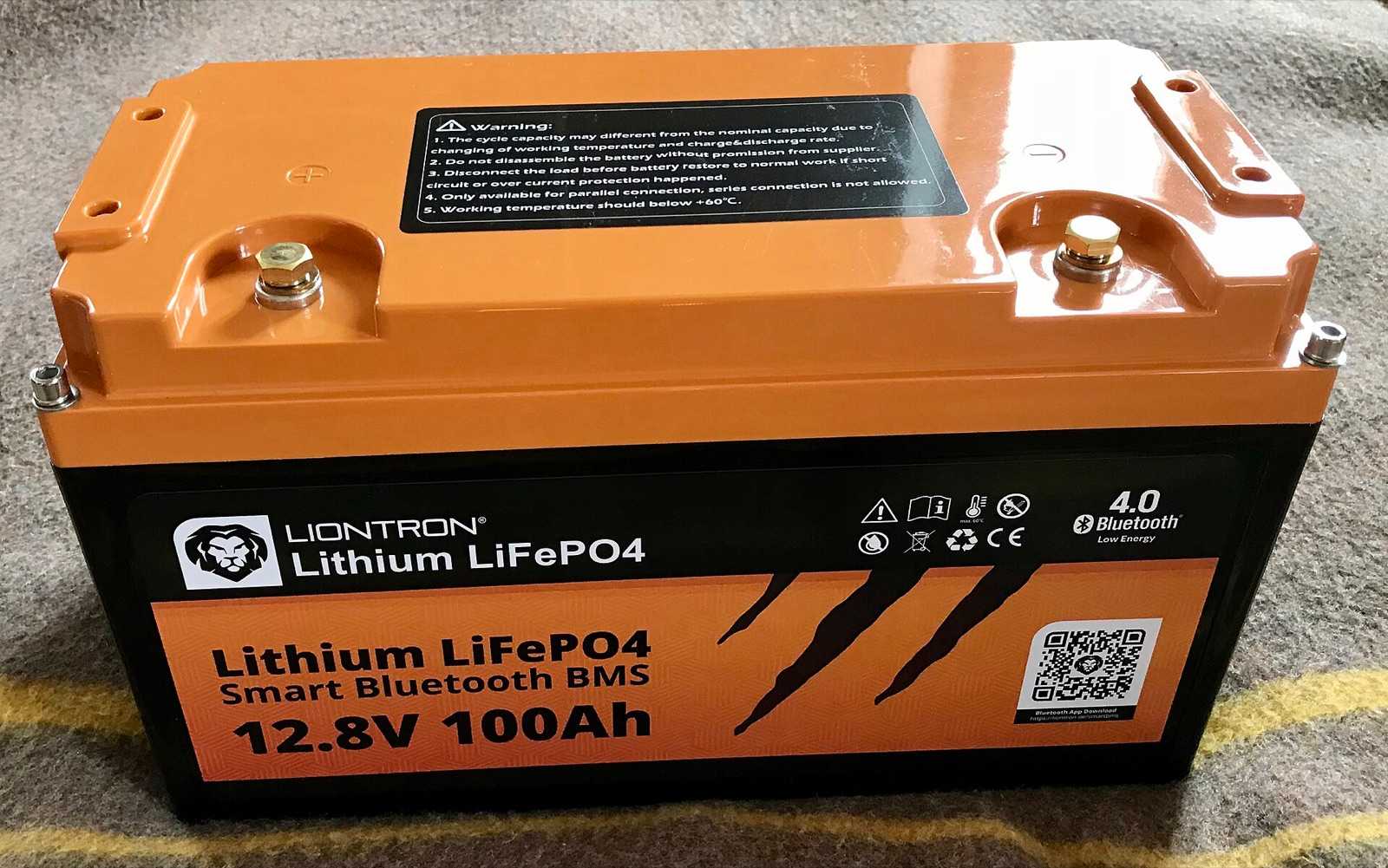
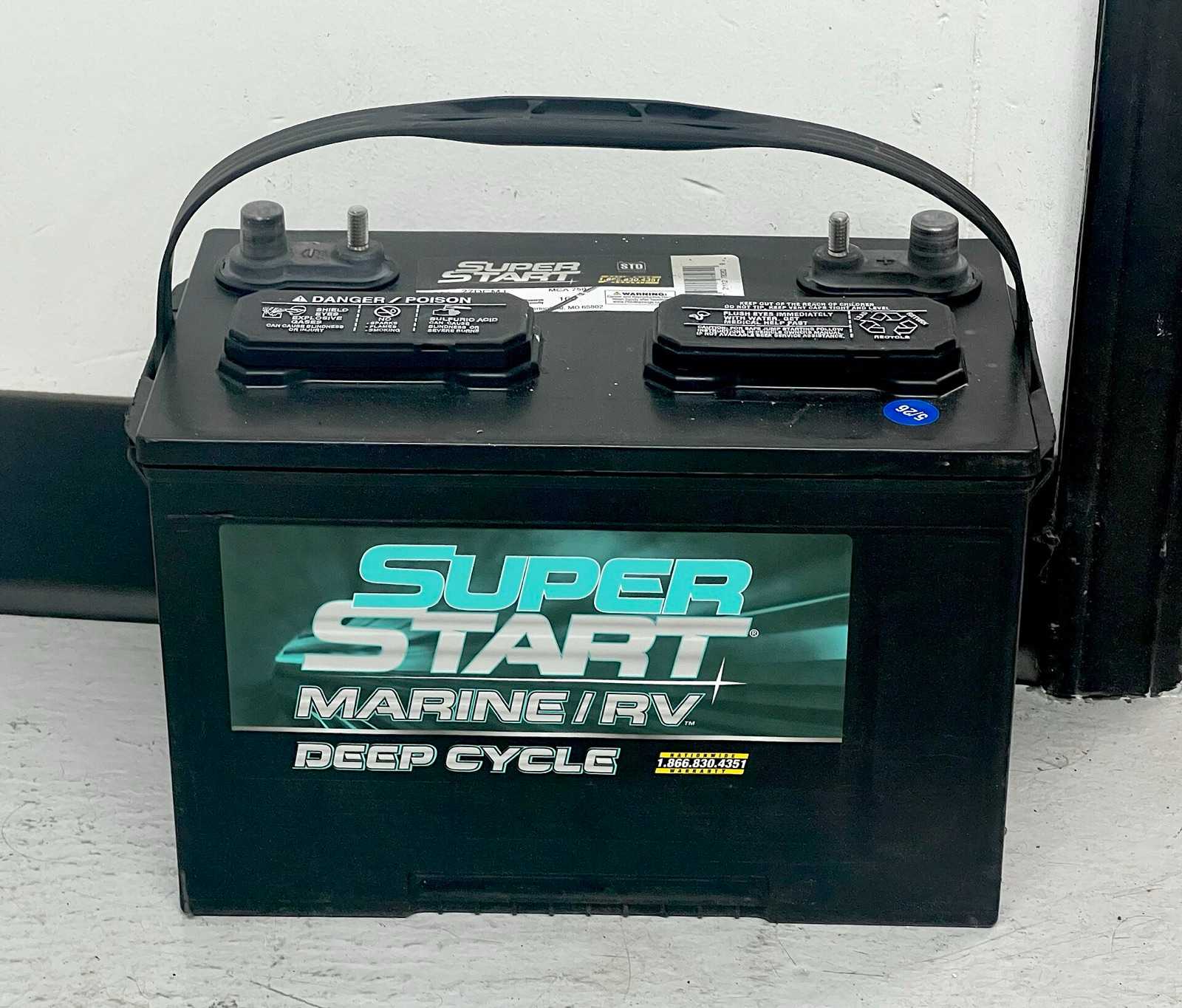
| Group 27 flooded | Group 31 AGM | 100 Ah LiFePO4 | |
|---|---|---|---|
| Typical rated capacity | 85 to 105 Ah | 100 to 110 Ah | 100 Ah |
| Recommended usable depth | 50% | 50% (some allow 80%) | 80 to 100% |
| Usable Ah | about 45 to 50 | about 50 to 55 | 80 to 100 |
| Typical weight | about 60 lb | about 65 to 70 lb | 25 to 30 lb |
| Rated cycles (manufacturer, at stated depth) | roughly 300 to 500 at 50% | roughly 500 to 800 at 50% | 2,000 to 5,000 at 80 to 100% |
| Voltage under load | sags steadily as it drains | sags steadily | holds 12.8 to 13.2 V until nearly empty |
These are typical spec-sheet ranges, not tests; check your specific battery’s data sheet. The practical result is that one 100 Ah lithium battery replaces roughly two lead-acid batteries in usable capacity at about a quarter of the weight. On a trailer with a tight tongue-weight margin, removing 90 lb from the tongue matters.
How lithium wants to be charged
| Stage | Flooded lead-acid (typical) | LiFePO4 (typical maker spec) |
|---|---|---|
| Bulk / absorption | 14.4 to 14.8 V | 14.2 to 14.6 V |
| Absorption hold | hours, tapering current | short, or none |
| Float | 13.2 to 13.5 V, indefinitely | none, or 13.4 to 13.6 V |
| Equalize | 15.5 V periodically | never |
| Temperature compensation | yes, about -0.03 V per °C for a 12 V battery | off |
| Charging below 32°F | allowed (reduced) | not allowed |
Lead-acid needs a long absorption phase and a float to stay full and avoid sulfation. Lithium accepts nearly full current until it’s almost full, then needs nothing. It is happy sitting at 50 to 80 percent and does not need to be held at 100 percent. Leaving it on a high float for months is not dangerous with a working BMS, but makers like Battle Born recommend storing partially charged and disconnected.
Step 1Identify your converter and what it does with lithium
Pull the cover on the power center and read the label, or look up the deck-mount unit’s model.
WFCO WF-8900 series (WF-8935, WF-8945, WF-8955). The standard models are lead-acid only. The manual lists 14.4 V bulk, 13.6 V absorption, 13.2 V float, but in practice many units sit at 13.6 V and rarely enter bulk (see the shore-power charging guide). At 13.6 V a LiFePO4 battery charges to roughly 90 percent and stops. It’s not harmful. It is slow, and the last 10 percent never arrives. WFCO’s lithium version, the WF-8955LIS, and the auto-detect “-AD” models hold 14.6 V for lithium. Owners of the base model can usually swap just the converter section rather than the whole power center.
Progressive Dynamics PD4600 series (PD4645, PD4655, PD4660) with Charge Wizard. Lead-acid profile: 14.4 V boost, 13.6 V normal, 13.2 V storage, and a periodic 14.4 V equalize-style pulse. That works with lithium the way the WFCO does, short of full. PD’s lithium versions, the PD4600L series (PD4645L, PD4655L, PD4660L), output a fixed 14.6 V. Do not run a lead-acid battery on an L model; the constant 14.6 V will boil it.
Old single-stage units (Magnetek 6300, Parallax 7300 at fixed 13.6 to 13.8 V). Same story as above: lithium charges slowly and short of full. The Magnetek units are worth replacing regardless.
Replacement options. A lithium-capable converter from the same brand as your power center is the cleanest fix. Alternatively, leave the converter on 13.6 V and let solar or a separate lithium charger handle top-off. A DC-DC charger between converter and battery also works, but is more wiring than most trailers need.
To check: plug in with the battery half charged and measure at the posts. 13.6 V that never rises over an hour is a lead-acid profile.
Step 2Understand what the BMS will do to you
Every lithium battery sold for RV use has a battery management system inside it. It can open the battery’s internal switch for several reasons, and when it does, the battery terminals go dead. Not dim. Dead.
- Low-voltage disconnect: typically when any cell falls near 2.5 V, around 10 to 11 V for the battery. Prevents permanent cell damage.
- High-voltage disconnect: if a charger pushes a cell above roughly 3.65 to 3.9 V. A misconfigured solar controller or an equalize cycle can trigger this.
- Over-current: a load above the BMS rating (100 A continuous and 200 A surge are common for 100 Ah batteries). A 2,000 W inverter at full load draws about 170 to 200 A, which trips a single 100 A BMS.
- Low-temperature charge cutoff: most refuse to accept charge below about 32°F. Discharging is usually allowed down to around -4°F.
- High-temperature cutoff: typically around 130 to 140°F.
What a trip looks like: the lights, furnace, fridge board, and the propane detector all die at the same instant, with no dimming beforehand. The battery may read 0 V or a few volts at the terminals. Most BMS units recover when the fault clears or when charge voltage is applied. Some converters, seeing no battery, won’t output; a small portable charger for a minute or two wakes it.
The furnace caveat matters in winter. If the BMS shuts off at 2 a.m., the furnace stops too, and so does the propane/CO detector. Monitor the battery’s state of charge and don’t count on the flat voltage curve to warn you.
Step 3Cold weather
Charging LiFePO4 below freezing plates lithium metal onto the anode and permanently damages the cells. The BMS prevents this by blocking charge, which means that on a 25°F morning your solar panels and converter are working and nothing goes into the battery.
Options, in order of simplicity:
- Mount the battery inside the heated envelope (a front pass-through or under a dinette seat) rather than on the tongue. Follow the battery maker’s venting guidance; LiFePO4 doesn’t vent hydrogen in normal use, but the compartment should still be sealed from the living space if possible and the cables protected.
- Buy a heated battery. Several makers sell self-heating models that use charge current to warm the cells before allowing charge.
- Add a battery heating pad controlled by a thermostat.
Lead-acid charges in the cold without any of this, at reduced efficiency, though a discharged flooded battery can freeze near 20°F.
Step 4Fusing and wire gauge
This is the change people skip, and the one with real consequences.
A 100 Ah LiFePO4 battery has very low internal resistance and, by maker data, can deliver thousands of amps into a dead short for the fraction of a second before something gives. A lead-acid battery of the same size delivers less, though still enough to start a fire. The fuse at the battery has to be able to interrupt that current safely, which is what the AIC (amps interrupt capacity) rating means.
- A standard ATC blade fuse is typically rated to interrupt about 1,000 A. Not adequate as the main battery fuse on lithium.
- Auto-reset thermal breakers common on trailer tongues are slow and corrosion-prone. Replace them.
- MRBF terminal fuses, which mount right on the battery post, are typically rated about 10,000 A at 14 V DC. Good for a battery feeding a converter and normal loads.
- Class T fuses are rated about 20,000 A AIC and are what most lithium makers and inverter makers specify for banks feeding a large inverter (roughly 1,000 W and up).
Put the main fuse within about 7 in of the battery positive, as ABYC E-11 calls for on boats and lithium makers recommend generally. Size the fuse to protect the wire, not the load: the fuse rating must be at or below the cable’s ampacity. A 2,000 W inverter needs roughly 2/0 to 4/0 AWG cable over a short run and a 250 to 300 A fuse; check the inverter manual for the exact pairing.
Existing trailer wiring for 12 V loads does not change. The converter output and the trailer’s 12 V distribution wiring are fine as they are.
Step 5Solar controller settings
A PWM or MPPT controller set to “flooded” will hold 14.4 to 14.8 V absorption for a long time and may run a periodic 15.5 V equalize. On lithium, that can trip the BMS high-voltage cutoff, and with temperature compensation on, a cold morning raises the target voltage further.
Switch to the controller’s LiFePO4 preset if it has one (Victron SmartSolar, Renogy Rover, and most current MPPT controllers do). If it only offers “user” settings, use the battery maker’s numbers, typically 14.2 to 14.6 V absorption, short absorption time, 13.4 to 13.6 V float or float disabled, equalize off, temperature compensation off. Cheap PWM controllers without a lithium setting are a common source of trouble and are worth replacing.
Step 6Charging from the tow vehicle
The 7-pin charge line usually runs 10 or 12 AWG wire 25 to 35 ft from the truck’s battery to the trailer battery. By the time you subtract voltage drop and the truck’s own alternator regulation, the trailer battery sees perhaps 13.0 to 13.4 V, and the current is a few amps to maybe 10 or 15 A at best on a discharged battery. The seven-pin guide shows the math.
For lead-acid that’s a slow trickle. For lithium it’s worse: at 13.2 V a LiFePO4 battery barely charges at all, and the low-impedance lithium battery can pull enough current on a short, fat run to stress the truck wiring or the fuse.
A DC-DC charger (Victron Orion-Tr Smart 12/12-18 or 12/12-30, Renogy 20 A or 40 A DC-DC, and similar) mounted at the trailer battery takes whatever voltage arrives and outputs a correct lithium profile at a fixed current. It’s the answer for anyone who expects to charge while driving. Some units can also limit input current to protect the truck’s wiring and include a smart-alternator mode for newer trucks.
Alternator concerns apply mostly to motorhomes and to vans charging large lithium banks directly from the engine alternator, where the battery can demand full alternator output for a long time and overheat it. On a travel trailer the 7-pin wire limits current long before the alternator notices.
Cost per usable amp-hour (assumption-driven)
This math depends entirely on the assumptions, so here they are. Assume a Group 27 flooded battery at about $150, 50 usable Ah, 400 cycles before it’s at end of life. Assume a 100 Ah LiFePO4 at about $350, 90 usable Ah, 3,000 cycles.
- Flooded: $150 ÷ (50 Ah × 400 cycles) = about $0.0075 per usable Ah delivered.
- LiFePO4: $350 ÷ (90 Ah × 3,000 cycles) = about $0.0013 per usable Ah delivered.
That ratio looks decisive, but it assumes you’ll actually cycle the battery thousands of times. A trailer used 20 weekends a year on shore power cycles the battery maybe a few dozen times a year, and the flooded battery dies of age (5 to 7 years with good care) long before it reaches its cycle count. Add the converter or DC-DC charger and the fuse upgrade to the lithium side of the ledger too. Plug in your own prices and camping pattern.
When lead-acid is still the right call
- You camp mostly on shore power, a weekend at a time. The battery’s main job is to run the slide and the jacks in the driveway. A flooded or AGM Group 24 or 27 is cheap and does this fine.
- The trailer sits outdoors in freezing weather most of its life and the battery lives on the tongue.
- You don’t want to touch the converter, the fuse, or the solar controller. A drop-in on a lead-acid charge system works, but it’s not getting what you paid for.
If you boondock, run a furnace through cold nights, or have a CPAP or an inverter, lithium’s usable capacity and flat voltage are worth the system changes.
Symptom → likely cause after a lithium swap
| What you see | Most likely | Check |
|---|---|---|
| Battery app says 85 to 92% and never reaches 100% on shore power | Converter on lead-acid profile at 13.6 V | Measure at battery; consider lithium converter |
| Everything died instantly overnight | BMS low-voltage disconnect | App history; apply charge voltage |
| Solar panels in full sun, battery not charging on a cold morning | Low-temperature charge cutoff | Battery temperature in app |
| BMS trips when the microwave runs on the inverter | Over-current, inverter larger than BMS rating | BMS continuous rating vs inverter draw |
| BMS trips during solar charging | High-voltage cutoff from flooded/equalize profile | Controller battery type setting |
| Barely charges while towing | 7-pin voltage drop | Add DC-DC charger |
Stop and call a certified RV technician or a qualified electrician if: a lithium battery is swollen, hot to the touch at rest, or smells; cables or a fuse holder are discolored or melted; a new fuse blows on reconnection; you are wiring an inverter large enough to need cable above 2 AWG and haven't crimped and fused heavy cable before; or the change involves rewiring the 120 V side of a converter or inverter-charger. A poorly crimped 2/0 lug on a lithium bank is a fire.
Parts and tools mentioned
- Lithium-capable converter: WFCO WF-8955LIS or Progressive Dynamics PD4645L / PD4655L / PD4660L, matched to your power center
- DC-DC charger: Victron Orion-Tr Smart 12/12-18 or 12/12-30, Renogy 20 A or 40 A DC-DC
- MRBF terminal fuse, or Class T fuse and holder for inverter banks
- Battery cable sized to the fuse and run length, with crimped lugs
- Solar charge controller with a LiFePO4 preset (Victron SmartSolar, Renogy Rover)
- Shunt-based battery monitor (Victron SmartShunt) if the battery has no app
Questions people ask next
Can I mix a lithium battery with my existing lead-acid battery? No. The voltages differ enough that the lithium charges and discharges into the lead-acid continuously. Replace the whole bank with one chemistry.
Will my WFCO hurt a lithium battery? Not in normal use. It just stops short of full. The risk is low; the cost is slow charging.
Do I have to change the converter? No, if you’re fine charging to about 90 percent and letting solar finish. Yes, if you want full, fast charging on shore power.
Photos

Manuals and references consulted
- WFCO WF-8900 Series Power Center owner's manual (charging stages) and WF-8955LIS lithium model literature
- Progressive Dynamics PD4600 Series owner's manual (Charge Wizard) and lithium-model PD4600L literature
- Battle Born Batteries LiFePO4 charging parameters, BMS cutoffs, and fusing guidance
- Victron Energy Orion-Tr Smart DC-DC charger manual and SmartSolar MPPT manual (battery presets)
- Trojan Battery Company deep-cycle flooded battery specifications
- ABYC E-11 AC and DC Electrical Systems on Boats (overcurrent protection near the battery, interrupt rating)