How to Test a Deep-Cycle RV Battery With a $15 Multimeter (and When You Need a Load Test)

Deep-cycle battery test order
- Off charge, burn surface 10 A for 2-3 min Reading runs high
- Rest 4+ hours Parasitic draw skews
- Read posts, rested 12.6 V = full Not charged, or sulfated
- Load 10 A, watch sag Hold above 11.5 V Weak or sulfated
- Hydrometer each cell 1.265 full Spread > 0.050, bad cell
- Carbon-pile load test Hold above 9.6 V Shorted cell
- 20-hour capacity test Run to 10.5 V Under 60%, replace
Battery runtime calculator
Tick the loads you run, set the bank and the temperature, get days of runtime and the solar to break even.
Open the calculator →Watch it done
Videos are from the channels named, not Chock & Level. Where a video and your manual disagree, follow the manual. Playing a video loads YouTube, which sets its own cookies.
The battery reads fine on the monitor panel, you unplug, and the furnace quits at 3 a.m. Or it’s three years old and you want to know whether to replace it before the trip. Either way the question is the same: is this battery worn out, or just not charged.
A multimeter answers the first question directly; capacity, which is what dies with age, has to be inferred from voltage under load or measured with a capacity test. Most “dead” batteries in order of what’s actually wrong: never fully charged by the converter, surface charge fooling the owner into thinking it was full, sulfated from sitting discharged, and finally a shorted cell.
You need a multimeter that reads DC volts to two decimals, safety glasses, and a known load you already own, like the water pump or the furnace blower. A hydrometer adds about $10 and is the single most useful tool for a flooded battery.
Quick answer. Pull the battery off charge, turn on the lights for two minutes to burn off surface charge, then let it rest at least 4 hours (overnight is better). Read the posts. 12.6 V or above is full; 12.2 V is half; 12.0 V is a quarter for a flooded battery at about 77°F. Then run the furnace blower or water pump and watch the meter: a battery that rested at 12.4 V and drops below about 11.5 V under a 10 A load is weak. If it rests fine and sags hard, the capacity is gone and a load test at an auto parts store or a 20-hour capacity test confirms it.
What voltage can and can’t tell you
A lead-acid battery is six cells in series, and the open-circuit voltage of each cell tracks the acid concentration, which tracks how much charge is left. So a rested voltage is a decent fuel gauge. It is not a health gauge. A battery with 30 percent of its original capacity left still rests at 12.7 V when full; it just gets to 12.0 V four times faster than it used to.
Step 1Get a true resting voltage
Voltage right off the charger lies. A flooded battery that just came off a 14.4 V converter will read 13.0 to 13.3 V for hours because of surface charge, a layer of concentrated acid at the plate surface that hasn’t diffused into the bulk electrolyte. A battery that just ran the furnace all night reads low for the same reason in reverse.
- Disconnect the charge source: unplug shore power, disconnect solar, or flip the battery disconnect, which also removes parasitic loads that drag the reading down.
- Burn off the surface charge. Turn on a 5 to 10 A load for two to three minutes: the water pump with a faucet cracked, or the furnace blower, or a handful of incandescent lights. Then turn it off.
- Wait four hours minimum. Overnight is what the manufacturer tables assume.
- Read directly on the lead posts, not the clamps. Red probe to positive, black to negative, meter on DC volts.
Step 2Convert the reading to state of charge
These are approximate resting voltages at about 77°F, drawn from Trojan’s and Lifeline’s published tables and the lithium makers’ charts. Your battery’s own data sheet beats this table if you have it.
| State of charge | Flooded lead-acid | AGM | LiFePO4 (rested) |
|---|---|---|---|
| 100% | 12.6 to 12.7 V | 12.8 to 12.9 V | 13.3 to 13.4 V |
| 75% | 12.4 V | 12.6 V | 13.2 to 13.3 V |
| 50% | 12.2 V | 12.3 V | 13.1 to 13.2 V |
| 25% | 12.0 V | 12.0 V | 13.0 V |
| 0% (take it off load) | 11.8 V or lower | 11.8 V or lower | 12.0 to 12.8 V, then BMS cuts off |
Two things to notice. AGM runs about 0.1 to 0.2 V higher than flooded at the same state of charge, so an AGM reading 12.6 V is three-quarters full, not full. And lithium iron phosphate is nearly flat from 90 percent down to 20 percent; the whole usable range lives between 13.0 and 13.3 V. A LiFePO4 bank reading 13.1 V could be at 30 percent or 60 percent, and a $15 meter can’t tell you which. For lithium, a shunt-based monitor (Victron SmartShunt, BMV-712, or the battery’s own Bluetooth app if it has one) is the state-of-charge tool, and voltage is only useful at the extremes.
Temperature. Resting voltage shifts only a few hundredths of a volt with normal weather, so the table holds. Available capacity is what drops: a flooded battery at 32°F delivers roughly 70 to 80 percent of its 77°F capacity, and near half at 0°F. Hydrometer readings do need correcting; see step 4.
Step 3Watch the voltage under a known load
Here is the test the multimeter is actually good at. A battery with healthy plates holds voltage under a moderate load; a worn or sulfated one sags, because its internal resistance has climbed.
Use a load you already own and know the draw of. Typical figures:
- Furnace blower: 7 to 11 A on common Suburban and Atwood/Dometic units (higher on 35,000 to 40,000 BTU/h models)
- Water pump, running against an open faucet: 5 to 8 A (a Shurflo 4008 is rated about 7.5 A at max)
- Each incandescent 12 V ceiling fixture: about 1.5 A per bulb
- A 12 V 60 W halogen bulb: about 5 A
Leave the meter on the posts, start the load, and read after 15 to 30 seconds once the number settles.
- Starting at 12.4 V or better, drops to 12.0 to 12.2 V under a roughly 10 A load: normal for a Group 24 or 27 in decent health.
- Drops below about 11.5 V from a 12.4 V rest under 10 A: weak. That is a rule of thumb, not a standard, but a battery doing this will not run a furnace through a cold night.
- Drops below 11.0 V, or keeps falling while you watch: the capacity is mostly gone, or a cell is failing. Confirm with step 4 or 5.
- Falls off a cliff from a healthy-looking rest voltage: classic sulfated battery. It looks full and has almost nothing in it.
Then turn the load off. A good battery recovers to within 0.1 V of rest inside a minute; a tired one crawls back.
A battery that rested at 12.0 V and sags to 11.3 V hasn’t failed; it was a quarter full. Charge, rest, and retest. Condemning a discharged battery is the most common mistake.
Step 4Hydrometer, for flooded batteries only
A hydrometer reads the specific gravity of the electrolyte, which is the most direct state-of-charge measurement there is, and the only cheap way to find one bad cell among six. Sealed AGM and gel batteries can’t be tested this way; skip to step 5.
Put on glasses and gloves. Pull the cell caps. The plates should be covered by about 1/4 to 1/2 in of electrolyte; if they’re exposed, add distilled water to just cover them, charge the battery, and come back, because a reading from a cell you just watered is meaningless.
Squeeze the bulb, draw enough electrolyte to float the indicator, hold it at eye level, read the scale, and return the electrolyte to the same cell. Write each reading on a strip of tape.
| Specific gravity (corrected to 80°F) | State of charge |
|---|---|
| 1.265 to 1.280 | 100% |
| 1.225 to 1.235 | 50% |
| 1.190 | 25% |
| 1.155 or lower | Discharged |
Correction: add 0.004 to the reading for every 10°F the electrolyte is above 80°F, and subtract 0.004 for every 10°F below. A battery at 40°F reading 1.250 is really about 1.234, roughly half charged. Many hydrometers have a built-in thermometer for exactly this.
What matters more than the absolute number is the spread. Six cells within 0.030 of each other is a healthy battery, charged or not. Any cell more than 0.050 below the others is a bad cell, and the battery is finished no matter what the voltage says. A dead cell often reads below 1.150 while its neighbors sit at 1.260, and the battery as a whole rests around 10.5 V.
A battery that reads uniformly low across all six cells after a full charge and rest is sulfated, not shorted. Trojan’s user guide allows an equalizing charge for flooded batteries (around 15.5 V for a few hours, monitoring temperature) which sometimes brings specific gravity back up. Never equalize an AGM or gel battery; their manufacturers prohibit it.
Step 5The carbon-pile load test
Any auto parts store will do this for free. The tester clamps on and applies a heavy load, by the Battery Council International method half the battery’s CCA rating for 15 seconds, and the battery passes if it stays above 9.6 V at 70°F (the threshold drops a little in cold weather). Most stores now use a conductance tester instead, which estimates the same thing electronically without the heat.
Two cautions for RV batteries.
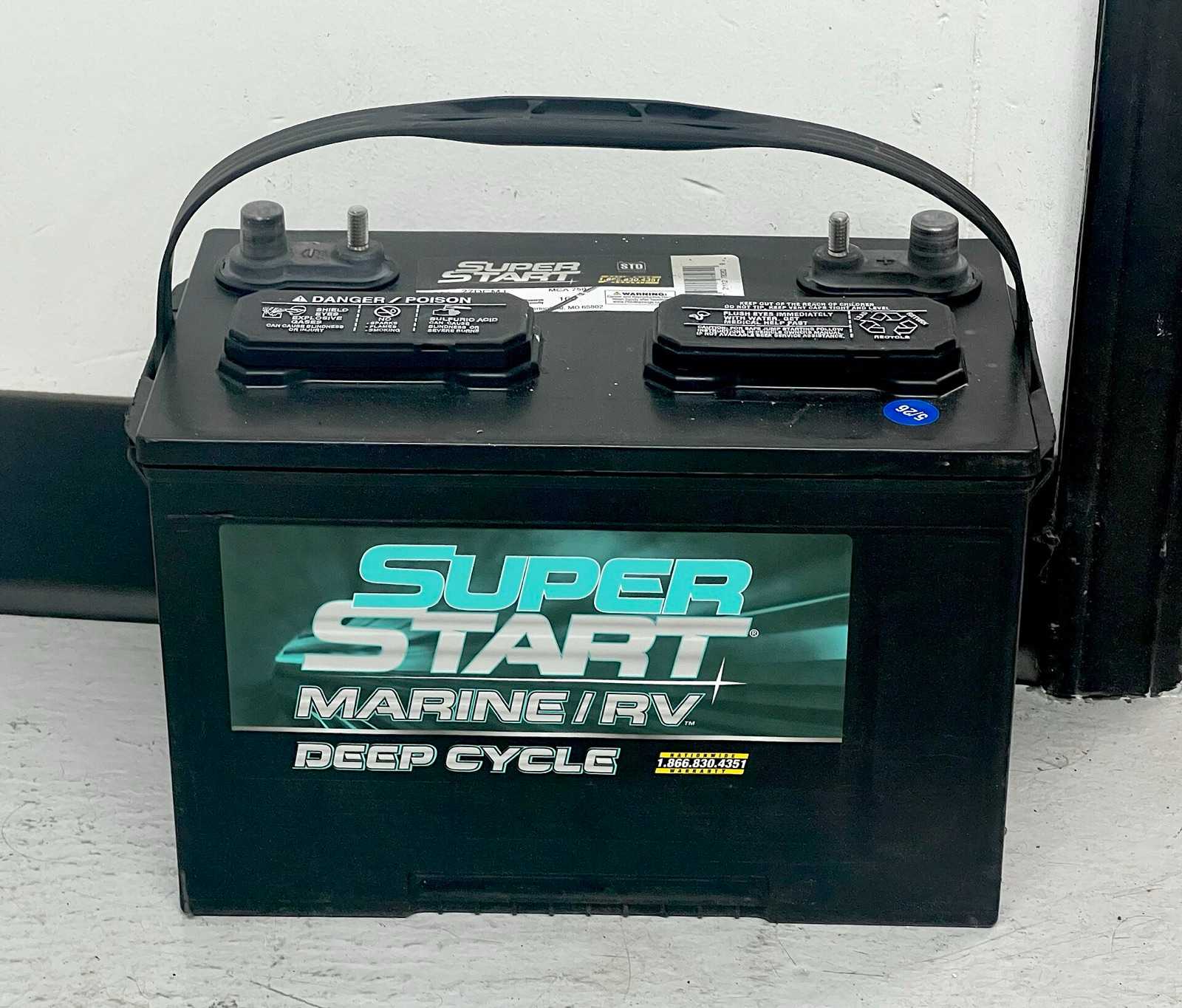
First, deep-cycle batteries often don’t carry a CCA rating. Marine batteries list MCA (marine cranking amps, measured at 32°F) and RC (reserve capacity in minutes at 25 A). If the tester asks for CCA and you only have MCA, MCA is roughly 20 to 25 percent higher than CCA for the same battery. If you have only an Ah rating, a common tester-manual rule is to load at about three times the Ah figure. Tell the counter person it’s a deep-cycle, not a starting battery.
Second, this test checks a starting battery’s job. It catches a shorted cell or bad sulfation, but not a deep-cycle battery that has lost 40 percent of its amp-hours but can still crank. For a trailer battery, RC and Ah are the ratings that matter, and the only test that measures them is step 7.
Step 6Reading the failure patterns
Shorted cell. The battery rests around 10.5 V (five good cells at 2.1 V each). The charger ramps to full voltage in minutes and the “charged” light comes on, then the battery is flat an hour later. One hydrometer cell reads far below the rest. The case near that cell may be warm or slightly bulged during charging. There is no fix.
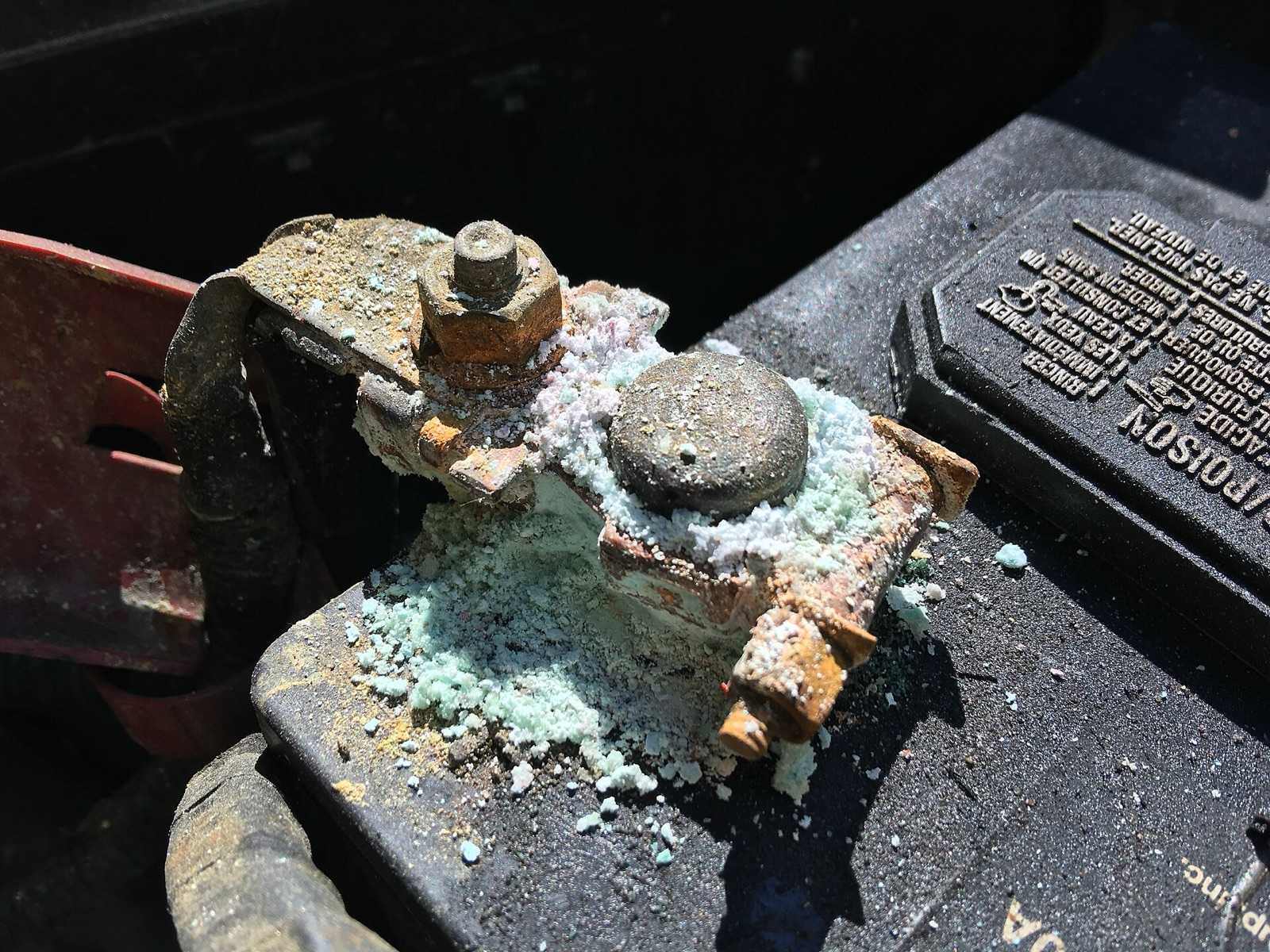
Sulfated. The battery sat discharged for weeks or months, often over winter without a trickle charger, or lived on a converter that never left 13.2 V. Lead sulfate crystals hardened on the plates. Symptoms: won’t accept much current, the charger’s voltage climbs to 15 V or more almost immediately while the current stays low, specific gravity is low and uniform, and the voltage under load collapses. Light sulfation sometimes responds to an equalizing charge (flooded only). Heavy sulfation does not.
Normal aging. Everything above tests acceptable; it just doesn’t last the night anymore. Lead-acid capacity fades with cycles and years; that’s the end of the curve, not a fault. Step 7 puts a number on it.
Step 7A real capacity test with a known load
If you want a number instead of a judgment, run a 20-hour discharge. Battery Ah ratings are defined at the 20-hour rate: a 100 Ah battery is one that delivers 5 A for 20 hours before reaching 10.5 V at 80°F.
- Fully charge and rest the battery.
- Connect a load equal to the rated Ah divided by 20. For a nominal 80 Ah Group 24, that’s about 4 A; a 12 V 50 W bulb or a couple of incandescent fixtures gets you close. Measure the actual current with a clamp meter or an inline meter; the number you write down is what you measure, not the label.
- Note the start time. Check voltage every hour or two. Stop when the battery hits 10.5 V under load.
- Hours × amps = usable capacity.
A battery delivering 80 percent of its rating is at the industry definition of end of life. Below about 60 percent, replace it; it can’t be trusted overnight and it will take the charging system with it in time, because the converter keeps trying to fill a bucket that leaks.
For a lithium bank, the capacity test is the only honest health check: run it to the BMS low-voltage cutoff (most trip around 10 to 11 V) and compare to the rated Ah. A lithium battery reading 0 V is usually a sleeping BMS, not a dead battery; a few seconds of charge voltage wakes it.
Symptom → likely cause
| What you see | Most likely | Check |
|---|---|---|
| Rests at 12.0 to 12.2 V every morning on shore power | Converter not charging, or stuck in float | Converter output voltage; see the shore-power guide |
| Rests at 12.6 V, collapses under furnace load | Sulfation or lost capacity | Hydrometer spread; load test; capacity test |
| Rests around 10.5 V, charger says full in minutes | Shorted cell | Hydrometer, one cell far below |
| Charger voltage shoots to 15 V+, current stays low | Sulfated, won’t accept charge | Equalize if flooded; otherwise replace |
| Reads 13.1 V after charging, “full” on panel, dies by midnight | Surface charge, never actually full | Burn off surface charge, rest, re-read |
| One cell needs water constantly | That cell is overheating or shorting | Hydrometer; expect a bad cell |
| Lithium reads 0 V | BMS disconnect | Apply charge voltage briefly; check temperature |
| Lithium reads 13.1 V, no idea of SOC | Normal flat curve | Install a shunt monitor |
Stop and get help, or get the battery outside, if: you smell rotten eggs or see electrolyte bubbling hard during charging (a charging flooded battery vents hydrogen, which is explosive in a closed battery box; never make a spark, smoke, or connect a clamp near open cell caps); the case is bulged, cracked, or hot at rest; a lithium battery is swollen, hot, hissing, or smells; or acid has gotten on skin or in eyes (flush with water for 15 minutes, then medical care). Wear safety glasses for any hydrometer work. Remove rings and watches before putting a wrench on a battery terminal. A dead short across a deep-cycle battery can melt a wrench and spray molten metal.
Parts and tools mentioned
- Digital multimeter with DC volts to two decimals
- Battery hydrometer with temperature correction scale (flooded only)
- Safety glasses, nitrile gloves, baking soda for spills
- Distilled water
- Known loads: water pump, furnace blower, or a 12 V 50 to 60 W bulb for the capacity test
- Clamp meter or inline DC ammeter for measuring the test current
- Shunt-based monitor for lithium or any bank you want a real gauge on: Victron SmartShunt or BMV-712
- Carbon-pile or conductance load tester (auto parts store will have one)
Questions people ask next
My battery reads 12.8 V right after I unplug. Is it full? Probably not; that’s surface charge. Run a load for a couple of minutes, rest it four hours, and re-read. Flooded batteries settle to 12.6 to 12.7 V when truly full.
The auto parts store said it passed. Why does it die overnight? Their load test checks cranking ability for 15 seconds. Your furnace needs 20 to 30 Ah over eight hours. A battery can pass the first and fail the second. See the capacity test in step 7, and the furnace-overnight guide for the draw math.
Do I need the 20-hour test or is the load test enough? If the voltage-under-load test in step 3 is clearly bad, you have your answer and the capacity test just quantifies it. Run the 20-hour test when the quick tests are borderline and the battery is expensive enough that you’d rather know than guess.
Photos

Manuals and references consulted
- Trojan Battery Company, Deep-Cycle Flooded Battery User's Guide (state-of-charge voltage and specific gravity tables, equalizing procedure)
- Lifeline Batteries, AGM Technical Manual (resting voltage table, capacity test method)
- Battery Council International (BCI), Battery Service Manual (carbon-pile load test: half CCA for 15 seconds, 9.6 V minimum at 70°F)
- Battle Born Batteries, LiFePO4 voltage chart and BMS operating notes
- Victron Energy, SmartShunt and BMV-712 manuals (shunt-based state-of-charge monitoring)