RV Battery Not Charging on Shore Power
The 15-Minute Converter Test

Shore power to battery
- Pedestal, cord, breaker 120 V to converter Pedestal, GFCI, transfer switch
- Converter makes DC 13.2-14.4 V Dead converter
- Reverse-polarity fuses pass Two 30-40 A blades Blown fuse, fan still runs
- Disconnect switch closed Left in store position
- Inline breaker, fuse Under 0.3 V across Pitted auto-reset breaker
- Clamps and frame ground Under 0.1 V post-clamp Corrosion, loose lug
- Battery accepts charge Rests 12.6 V full Dead cell, sulfation, BMS
Not sure where to start?
Answer one check at a time, in the order the system works. The first "no" is where the fault is, and you jump straight to the step that fixes it.
Watch it done
Videos are from the channels named, not Chock & Level. Where a video and your manual disagree, follow the manual. Playing a video loads YouTube, which sets its own cookies.
You’re plugged in at a campground or in the driveway, the lights work, the fridge runs, and the battery still reads 12.1 V three days later. Unplug and the lights dim within an hour. Either the converter isn’t charging, or what it puts out never reaches the battery.
Most of the time the converter is fine. In order of likelihood: a battery disconnect switch left in the storage position, a blown reverse-polarity fuse on the converter board, a corroded or loose battery or ground connection, a failed auto-reset breaker on the battery lead, a battery too far gone to accept a charge, and only then a dead converter.
You need a multimeter that reads DC volts, a screwdriver for the converter cover, and about 15 minutes.
Quick answer. With shore power connected, measure DC volts at the converter output terminals. You want 13.2 to 14.4 V. Got it there but 12.x V at the battery? The problem is between them: disconnect switch, inline fuse or auto-reset breaker, dirty clamps, or the frame ground. Got only battery voltage at the converter output? Check the reverse-polarity fuses on the converter board (two 30 A or 40 A blade fuses on most units) before you condemn the converter. Got 13.6 V at the battery and it still won't rest above 12.2 V after a day? The battery is the problem.
How the converter is supposed to charge the battery
The converter turns 120 V AC from the pedestal into 12 V DC. It feeds the 12 V distribution panel (lights, pump, furnace, fridge board) and, through that same bus, the battery. Whatever the loads don’t use flows into the battery as charging current. There is no separate charger wire in most trailers; the battery and the converter share one bus.
Modern converters are multi-stage. The names differ by brand, but the voltages are close.
| Converter | Bulk / boost | Absorption / normal | Float / storage |
|---|---|---|---|
| WFCO WF-8900 series (WF-8955, WF-8945, WF-8935) | 14.4 V | 13.6 V | 13.2 V |
| Progressive Dynamics PD4600 series (PD4645, PD4655, PD4660) with Charge Wizard | 14.4 V | 13.6 V | 13.2 V, plus a 14.4 V equalize for 15 minutes every 21 hours |
| Progressive Dynamics PD9200 series (PD9245, PD9260) with Charge Wizard | 14.4 V | 13.6 V | 13.2 V |
| Parallax 7300 series, Magnetek 6300 series (older rigs) | none | 13.6 to 13.8 V single stage | none |
So a working converter on a partly discharged battery reads between 13.2 V and 14.4 V at its output, depending on stage. 13.6 V is the most common reading and it is correct. A reading of 12.x V or 0 V at the converter output means the converter is not charging anything.
Step 1Confirm the converter is getting 120 V
The converter is a 120 V appliance on its own breaker, usually labeled CONV in the AC section of the power center, typically 15 A. A tripped breaker can look like it’s on; switch it fully off, then back on.
Then walk upstream.
- Pedestal breaker. Flip it off and on. Pedestal breakers get weak and trip below their rating.
- Shore cord and adapter. A warm or discolored 30 A plug is a failing connection; it can pass enough for the lights and not enough for the converter under load.
- GFCI. In some rigs, more often older or small trailers, the converter sits on a GFCI-protected branch. Press reset on every GFCI outlet.
- Transfer switch. If you have an onboard generator, shore power passes through an automatic transfer switch. Burned relay contacts are a known failure, and the symptom is exactly this: some circuits work, the converter doesn’t. You should hear the relay click a few seconds after plugging in. No click, or a buzz, points at the switch.
If the microwave and outlets work and the CONV breaker is on, assume the converter has 120 V and move to the DC side. Don’t remove the 120 V panel cover and probe live terminals; the DC test in step 2 tells you what you need without that.
Step 2Measure at the converter DC output terminals
On a WFCO WF-8955 or a PD4600 the DC output is a pair of large lugs on the lower (converter) section of the power center, behind a cover held by two or four screws. Deck-mount units (PD9200, WFCO WF-9800 series, Parallax 7300) have the output on a terminal block or two heavy leads.
Set the meter to DC volts, red probe on the positive output, black on the negative or chassis ground, shore power connected.
- 13.2 to 14.6 V: the converter works. Go to step 4; the problem is between here and the battery.
- 12.0 to 13.1 V: you’re reading battery voltage back through the bus. The converter isn’t contributing. Go to step 3.
- 0 V, or the reading doesn’t change when you unplug shore power: same conclusion. Step 3.
A WFCO or PD fan that isn’t running proves nothing; both are temperature-controlled and stay off at low load.
Step 3Check the reverse-polarity fuses
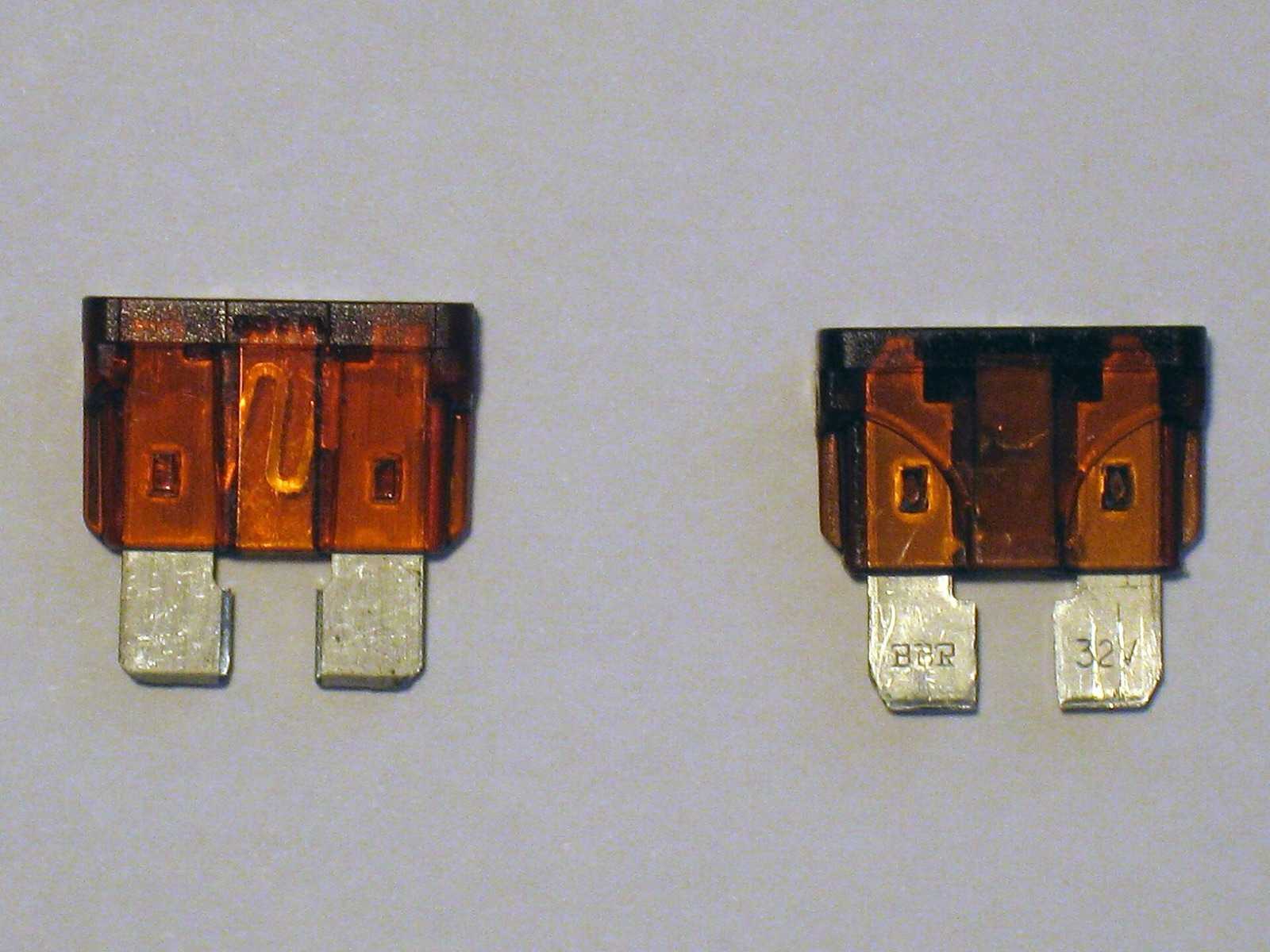
This is the hidden failure. WFCO, Progressive Dynamics, and most Parallax converters carry blade fuses on the converter board that protect it if someone connects the battery backwards. They also blow if a battery cable touches the frame during a swap, and sometimes from heat and age. When they blow, the fan may still run, the 12 V lights still work off the battery, and nothing charges.
On the WF-8955 there are two 40 A ATC blade fuses side by side on the converter board, visible once the lower cover is off. PD4600 series boards carry two or three 30 A fuses depending on output rating; PD9200 and Parallax 7300 units have them on the case. Smaller WFCO units use 30 A.
Pull each one and hold it to the light, or check continuity across the blades. One blown fuse is enough to stop charging. Replace with the same rating and keep spares.
If a new fuse blows immediately, there’s a short on the battery side or the battery is connected backwards. Find it before trying again. If the fuses are good and the output still reads battery voltage, the converter has failed. Go to step 7.
Step 4Measure at the battery and compare
Now put the probes directly on the battery posts, not the clamps. You want the same 13.2 to 14.4 V you saw at the converter, minus a small drop.
- Within 0.3 V of the converter reading: the charging path is good. If the battery still won’t come up over a day or two, go to step 5.
- More than 0.5 V lower, or 12.x V while the converter shows 13.6 V: something between them is open or resistive. Work through this list.
Battery disconnect switch. Many trailers built since about 2015 have a rotary or push-button disconnect near the battery or inside the entry. In the “store” or “off” position it isolates the battery from everything, including the converter. The lights still work on shore power because the converter runs them directly, which is why nobody notices. Check the position, then the owner’s manual; a few rigs are wired so the converter still charges with the switch off, most are not.
Inline fuse or auto-reset breaker. Between the battery positive and the trailer there’s usually a 30, 40, or 50 A protection device: an inline fuse in the battery box, or a thermal auto-reset breaker bolted to the tongue, a small metal can with two studs. The auto-reset type corrodes, the contact pits, and eventually it passes battery voltage with no load and drops out under charging current. Measure across its two studs with shore power on; more than a few tenths of a volt means it’s bad. Replace rather than clean.
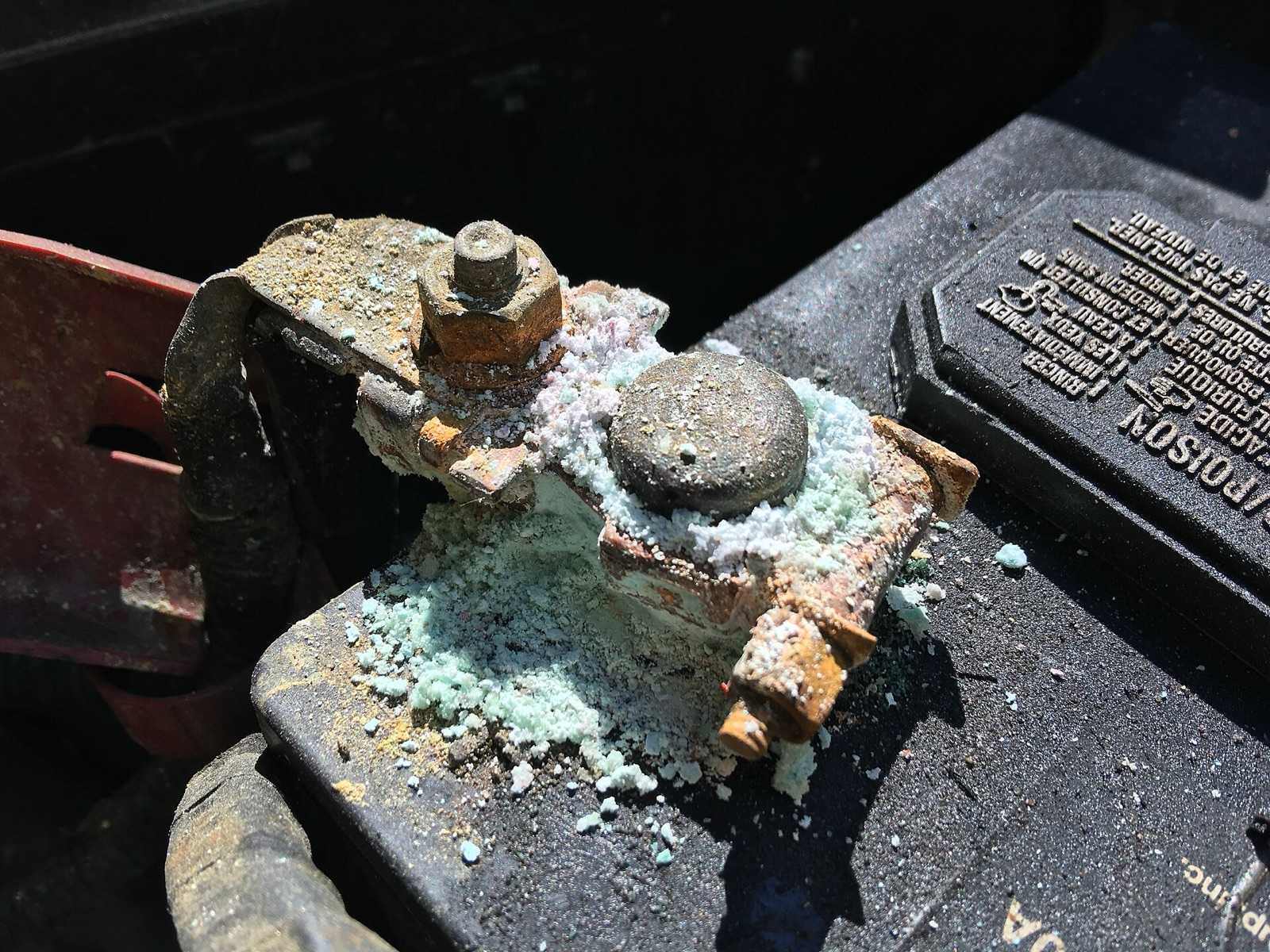
Terminals and clamps. Pull the clamps and look at the post and the inside of the clamp. White or green crust, or a clamp you can rotate by hand, is enough resistance to block charging. Clean both to bright metal, reassemble, tighten. Measure post to clamp with the converter running; anything above about 0.1 V means the connection is still bad.
Ground path. Follow the battery negative cable to where it bolts to the frame. Surface rust under the ring terminal, a self-tapping screw into thin steel, or a loose lug all produce the same symptom. Clean to bare metal, add a star washer, retighten. Check the converter’s own ground lug too.
Step 5Decide whether the battery is the problem
If the battery sees 13.6 V and won’t climb, or climbs and sinks right back to 12.0 V the moment you unplug, the battery is finished or close to it.
Pull the negative, let it rest a few hours (overnight is better), and read the post voltage.
| State of charge | Flooded lead-acid | AGM | LiFePO4 |
|---|---|---|---|
| 100% | 12.6 to 12.7 V | 12.8 to 12.9 V | 13.4 to 13.6 V |
| 75% | 12.4 V | 12.6 V | 13.3 V |
| 50% | 12.2 V | 12.3 V | 13.2 V |
| 25% | 12.0 V | 12.0 V | 13.0 V |
| Discharged | 11.8 V or lower | 11.8 V or lower | 12.0 to 12.8 V (BMS cuts off around 10 to 11 V) |
These are approximate resting voltages at around 77°F from the battery manufacturers’ published charts. Lithium voltage barely moves between 20 and 90 percent, so the LiFePO4 column is a poor fuel gauge; a shunt-based monitor is the real answer there.
A flooded battery that rests at 12.0 V after a full day on a working converter has a dead cell or heavy sulfation. Check the electrolyte; if plates are exposed, top up with distilled water, charge, and retest. A load test at an auto parts store settles it.
Step 6Converter stuck in float, or the wrong profile
A converter reading 13.2 V while the battery sits at 12.3 V is charging, just slowly. At 13.2 V a flooded battery eventually reaches roughly 90 percent, over days.
WFCO and bulk mode. WFCO’s manual says the WF-8900 series enters 14.4 V bulk when the battery is discharged and the DC load is high enough, and drops to 13.2 V float after about 44 hours without a significant load change. In practice many owners never see 14.4 V, and WFCO has acknowledged the unit is conservative about it. If yours sits at 13.6 V, that is normal WFCO behavior, not a fault. Running the furnace for a few minutes right after plugging in sometimes kicks it into bulk.
Progressive Dynamics Charge Wizard. The PD4600 and PD9200 “C” models have a status LED and a mode button; the blink legend is in the manual. Press the button to force boost mode when you know the battery is low. If it never leaves storage with a clearly discharged battery, the converter is probably reading the battery through a bad connection and thinks it’s full.
Lithium on a lead-acid converter. A LiFePO4 bank needs about 14.2 to 14.6 V to top off. A converter at 13.6 V gets it most of the way there, slowly; 13.2 V float leaves it well short. WFCO’s WF-8955-AD auto-detect and “LiS” lithium models, and Progressive Dynamics’ lithium versions of the PD4600 series, hold a constant 14.4 to 14.6 V. If you swapped to lithium and kept the original converter, slow charging is expected, not broken.
Lithium BMS cutoff. A LiFePO4 battery run flat disconnects itself; the terminals read 0 V or something odd like 4 V. Most BMS units wake when they see charging voltage, but some converters, seeing no battery, never try. A small portable charger connected for a minute usually wakes it. Below 32°F most lithium BMS units refuse to charge at all, by design.
Step 7Signs the converter is cooked
Open the converter cover, look, and smell.
- A sharp burnt-electronics smell, hot plastic and ozone.
- Brown or black discoloration on the board around the transformer or output capacitors.
- A loud buzz with no DC output, or a fan running flat out with no load.
- Output voltage that wanders, say 11 V to 15 V, or ripple that makes the lights flicker.
A converter that has 120 V, has good reverse-polarity fuses, and still puts out battery voltage or nothing at its own terminals is done. On a WFCO power center the converter is a separate module in the lower section; replace that module, or drop in a Progressive Dynamics PD4600 series unit sized to the original amperage. For deck-mount Magnetek 6300 units, poorly regulated and known for boiling batteries, the PD9200 or Parallax 7300 series are direct upgrades. Go bigger only if the DC output wiring and battery fuse are sized for it.
Symptom → likely cause
| What you see | Most likely | Check |
|---|---|---|
| 13.6 V at converter output, 12.x V at battery | Disconnect switch, inline fuse or auto-reset breaker, bad clamp or ground | Switch position; voltage across breaker studs; post-to-clamp drop |
| Battery voltage at converter output, fan runs | Blown reverse-polarity fuses | Pull and inspect the blade fuses on the board |
| 0 V at converter output, no fan, no hum | No 120 V to converter, or converter dead | CONV breaker, pedestal, GFCI, transfer switch |
| 13.6 V at battery, battery never rests above 12.2 V | Battery sulfated or dead cell | Electrolyte, rest voltage, load test |
| Converter only ever shows 13.2 V | Stuck in float, or lithium on a lead-acid profile | PD mode button; heavy load on WFCO; battery type vs. converter profile |
| Lithium battery reads 0 V | BMS low-voltage cutoff | Wake with a small charger; check temperature |
| Outlets work, converter doesn’t, rig has a generator | Transfer switch contacts | Listen for the relay click; have a tech check the switch |
Stop and call a certified RV technician or electrician if: the shore cord plug, adapter, or pedestal receptacle is melted or discolored; a breaker trips again after you reset it; you smell burning from the 120 V side of the power center; a replacement reverse-polarity fuse blows immediately; the transfer switch buzzes or shows heat damage; or the fix requires working inside the 120 V section of the panel with power on. Resetting breakers and GFCIs is a do-it-yourself job. Probing live 120 V bus bars is not.
Parts and tools mentioned
- Digital multimeter with DC volts and continuity
- ATC/ATO blade fuses, 30 A and 40 A, matched to the converter board
- Battery terminal brush, star washers for the frame ground
- Replacement auto-reset thermal breaker (match the stamped amperage) or inline fuse holder and fuse
- Converter options: WFCO WF-8955 replacement module; Progressive Dynamics PD4645 / PD4655 / PD4660 for power centers; PD9245 / PD9260 or Parallax 7345 / 7355 for deck mount
- Distilled water and a hydrometer for flooded batteries
Questions people ask next
Why do the lights work on shore power if the battery isn’t charging? Because the converter powers the 12 V panel directly and the battery is in parallel with it. With the disconnect open, a failed breaker on the battery lead, or a bad clamp, the loads run off the converter and the battery sits alone and uncharged.
Should my converter read 14.4 V? Only in bulk or boost mode on a discharged battery, and only for a while. 13.6 V is the normal reading on a WFCO or PD unit with a partly charged battery. 13.2 V is float. Any of the three is a working converter.
Can I leave the trailer plugged in all the time? With a multi-stage WFCO or PD converter, yes; float at 13.2 V is designed for that. Check the water in flooded batteries monthly anyway. With an old Magnetek 6300, no; those boil batteries, and the usual fix is to replace the converter.
Photos


Manuals and references consulted
- WFCO WF-8900 Series Power Center owner's manual (WF-8955PEC), charging mode description
- Progressive Dynamics Inteli-Power 4600 Series and 9200 Series owner's manuals; Charge Wizard operating description
- Parallax Power Supply 7300 Series and Magnetek 6300 Series converter documentation
- Trojan Battery and Lifeline Battery published state-of-charge voltage tables
- Battle Born Batteries LiFePO4 charging parameters and BMS low-voltage behavior