Travel Trailer Tongue Weight
How to Measure It and Why 10 to 15 Percent Matters
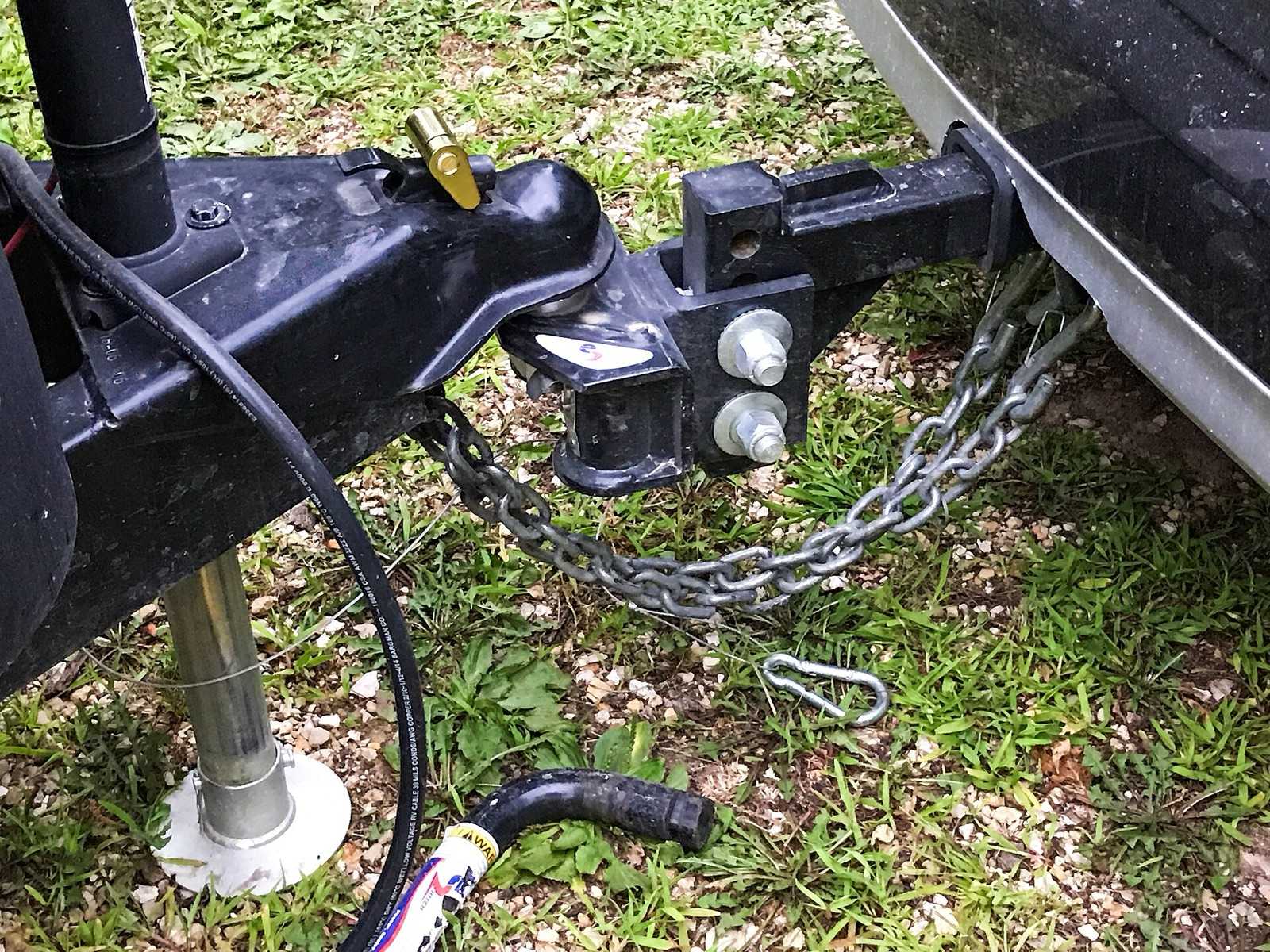

Tongue weight at a CAT scale
- Load as you tow Fuel, people, water, gear Brochure dry weight
- Chock, level, bars off Slope shifts tens of lb
- Weigh truck alone T1
- Weigh hitched, bars off T2 and trailer axles A Bars on reads low
- Tongue = T2 - T1 780 lb in example
- Divide by A + tongue Target 10-15% Under 10%, sway
- Check receiver and payload Sticker rating, door label
Tongue weight & payload calculator
Plug in your scale numbers and the door sticker; get the 10–15% window and the payload you have left.
Open the calculator →Watch it done
Videos are from the channels named, not Chock & Level. Where a video and your manual disagree, follow the manual. Playing a video loads YouTube, which sets its own cookies.
The trailer feels fine at 55 and nervous at 65. A semi passes and the back of the truck takes a step sideways. Or you’ve never towed this trailer and the brochure says the dry hitch weight is 580 lb, which tells you almost nothing about the trailer in your driveway with two propane cylinders, two batteries, a full fresh tank, and a generator in the pass-through.
Tongue weight is the part of the trailer’s weight that rests on the hitch ball instead of the trailer axles. For a conventional travel trailer it should be 10 to 15 percent of the trailer’s actual loaded weight, and most sway complaints come from being under 10. The brochure number is measured empty, with no propane and no battery, and it is routinely a few hundred pounds low once the trailer is loaded for a trip.
You can measure it three ways: at a truck-stop CAT scale, with a dedicated tongue scale, or with a bathroom scale and a lever. The tongue weight calculator takes the scale readings and returns the percentage.
Quick answer. Load the trailer and truck exactly as you tow. At a CAT scale, weigh the truck alone, then hitched with the weight distribution bars off. Tongue weight is the second truck weight minus the first. Divide by the trailer's total weight (trailer axle reading plus tongue weight). Under 10 percent: move weight forward of the trailer axle. Over 15 percent, or over the receiver's sticker rating: move weight back. Then check that the tongue weight fits inside your truck's payload.
Why 10 to 15 percent, and what it has to do with sway
A trailer is a mass hanging off a pivot. Where that mass sits relative to the axle decides whether the trailer follows the truck or tries to steer it.
Put the trailer’s center of mass ahead of the axle and the coupler carries weight. When a crosswind or a passing truck nudges the trailer sideways, the trailer’s own weight pulls the nose back in line behind the ball, and the yaw damps out in a swing or two. Put the center of mass at or behind the axle and the coupler carries little or nothing. Now the trailer behaves like a dart thrown fins-first: any sideways push grows, each swing is bigger than the last, and the truck’s rear axle becomes the pivot. Above a critical speed, which drops as tongue weight drops, the trailer will not settle on its own. A friction sway bar or a WDH with built-in sway control raises that speed; it does not fix the balance.
The 10 percent floor is a tested minimum. SAE J2807, the standard behind current tow ratings, specifies 10 percent tongue weight for conventional trailers in its handling tests, and some hitch and trailer manufacturers call for 12 to 13 percent as a working target. The 15 percent ceiling is about the truck: beyond it you hit the receiver rating, the rear axle rating, and payload before you hit a trailer handling problem.
Too little is the dangerous direction. A trailer at 8 percent may tow fine on a calm day and sway at 62 mph the first time a semi passes. A trailer at 16 percent squats the truck and lightens the steering, which you will feel and can correct, and a weight distribution hitch moves some of that load back to the trailer axles and the truck’s front axle. Light tongue is the one that sneaks up on people.
What the percentage is a percentage of
Loaded trailer weight, not dry weight and not GVWR. Everything on board as you actually tow:
- A 20 lb propane cylinder weighs about 37 lb full (tare weight stamped on the collar as “TW,” typically 17 to 18 lb, plus 20 lb of propane). A 30 lb cylinder runs about 55 lb full. Two 30s on the A-frame is 110 lb almost entirely on the tongue.
- A Group 27 flooded battery weighs about 60 lb; a Group 24 about 50 lb; a 6 V golf cart battery about 65 lb. A 100 Ah lithium battery is 25 to 30 lb. These ride on the A-frame or in the front pass-through on most trailers.
- Fresh water is 8.34 lb per gallon. A 40 gal tank is 334 lb. Where the tank sits matters more than how big it is: a fresh tank ahead of the axle adds tongue weight when full, a tank behind the axle subtracts it. A 6 gal water heater adds another 50 lb, usually forward.
- The front pass-through bay is the biggest variable. A 2,200 W inverter generator is 45 to 50 lb, and chairs, tools, leveling blocks, and the sewer kit add up fast, all well ahead of the axle.
- Gray and black tanks are usually at or behind the axle. Traveling with them full subtracts tongue weight.
A trailer that weighs 5,200 lb dry can easily weigh 6,400 lb loaded, and the 10 percent minimum moves from 520 lb to 640 lb.
Step 1Chock and set up before any measurement
Chock both trailer wheels on both sides. Lower the tongue jack onto a pad, not bare asphalt on a hot day. If you use a weight distribution hitch, read its manual for the order: most want the tongue raised with the jack (lifting truck and trailer together) to take tension off the spring bars before you unlatch the brackets. A loaded spring bar stores real energy and the snap-up lever can hurt you if you fight it from the wrong side.
Measure on level ground. A trailer nose-down or nose-up by a few degrees shifts weight between coupler and axles by tens of pounds.
Step 2CAT scale, three weigh-ins (method A)
This is the most accurate method for most people because it uses a certified scale and gives you the trailer’s total weight at the same time. CAT scales at truck stops have three platforms: steer axle on the first, drive axle on the second, trailer axles on the third. Pull on, stay in the vehicle, press the call button. The first weigh is about 13 to 14 dollars at this writing; reweighs within 24 hours are a few dollars more.
Load the truck and trailer as you tow: fuel full, everyone who rides in the cab in the cab, the dog, the cooler, the water you plan to carry.
Weigh-in 1: truck alone. Unhitch in the parking lot (chocked, see step 1) and drive the truck onto the scale. Record steer, drive, and gross. Call the gross T1.
Weigh-in 2: hitched, spring bars off. Hitch up but leave the WDH bars unhooked, or if you don’t run a WDH, hitch normally. Record steer, drive, truck gross (steer plus drive), and the trailer axle platform. Call the truck gross T2 and the trailer axle reading A.
Weigh-in 3: hitched, bars on. Tension the bars as you normally tow and reweigh. This weigh-in is not for tongue weight; it is for checking the WDH setup.
The arithmetic:
- Tongue weight = T2 − T1. With the bars off, every pound the trailer puts on the ball shows up as added truck weight.
- Loaded trailer weight = A + tongue weight. The trailer axles carry everything the coupler doesn’t.
- Percentage = tongue weight ÷ loaded trailer weight × 100.
With example numbers: T1 = 6,100 lb, T2 = 6,880 lb, A = 5,420 lb. Tongue weight is 780 lb. Loaded trailer is 5,420 + 780 = 6,200 lb. 780 ÷ 6,200 = 12.6 percent.
Weigh-in 3 tells you what the bars are doing. Compare its steer axle to weigh-in 1. With bars on, the front axle should recover a good portion of what it lost in weigh-in 2; most tow vehicle manuals give a target, often full restoration or a stated percentage. Check your truck’s towing section, not the hitch box.
Step 3a tongue weight scale (method B)
Hydraulic pad scale. The Sherline LM-1000 (1,000 lb capacity) and LM-2000 (2,000 lb) are the usual ones; a hydraulic cylinder under a steel cap drives a gauge. Set the scale on a solid, level pad directly under the coupler, with blocking under it so the coupler will sit at the height it rides at when hitched. Raise the tongue with the jack, slide the scale under, lower the coupler onto the cap, read the gauge. The trailer must be chocked; the scale has no way to resist roll.
Gauge in the ball mount. The Weigh Safe hitch builds a hydraulic gauge into the drop ball mount. Lower the coupler onto the ball and read the gauge before you hook safety chains, the breakaway cable, or spring bars. Once the bars are on, the gauge reads the distributed number, which is lower than true tongue weight; Weigh Safe’s instructions say to read it before the bars go on.
Both are accurate to within a few percent of reading. Neither tells you the trailer’s total weight, so you still need a CAT scale once to get the denominator.
Step 4bathroom scale and a lever (method C)
Most bathroom scales top out at 300 to 400 lb and a loaded trailer’s tongue is usually 500 to 1,000 lb. The fix is a lever that puts a known fraction of the load on the scale. You need a stiff beam (a 4 ft length of 2x4 on edge or a steel pipe), a short piece of pipe for a fulcrum, blocks, and a tape measure.
- Set the fulcrum pipe on a block and the bathroom scale on a stack of blocks so the beam will sit level across both, 3 ft apart center to center.
- Lay the beam across them. Note the scale reading with just the beam; this is your tare.
- Mark the beam 1 ft from the fulcrum. Put a short block there for the coupler to sit on, so the coupler ends up at ride height.
- Lower the coupler onto the block. Read the scale and subtract the tare.
- Tongue weight = (scale reading − tare) × 3.
The 3 comes from the distances: the load sits 1 ft from the fulcrum and the scale 3 ft from it, so the scale sees one third. A 2 ft beam with the load at 1 ft puts half the load on the scale, which only works for light trailers (a 700 lb tongue is 350 lb on the scale, at the limit of many).
Limits: a one-inch error in the 12 in load position is an 8 percent error in the result, and bathroom scales lose accuracy near the top of their range. Treat the result as plus or minus 50 lb and verify at a CAT scale when you can.
Step 5Check the result against the truck and the hitch
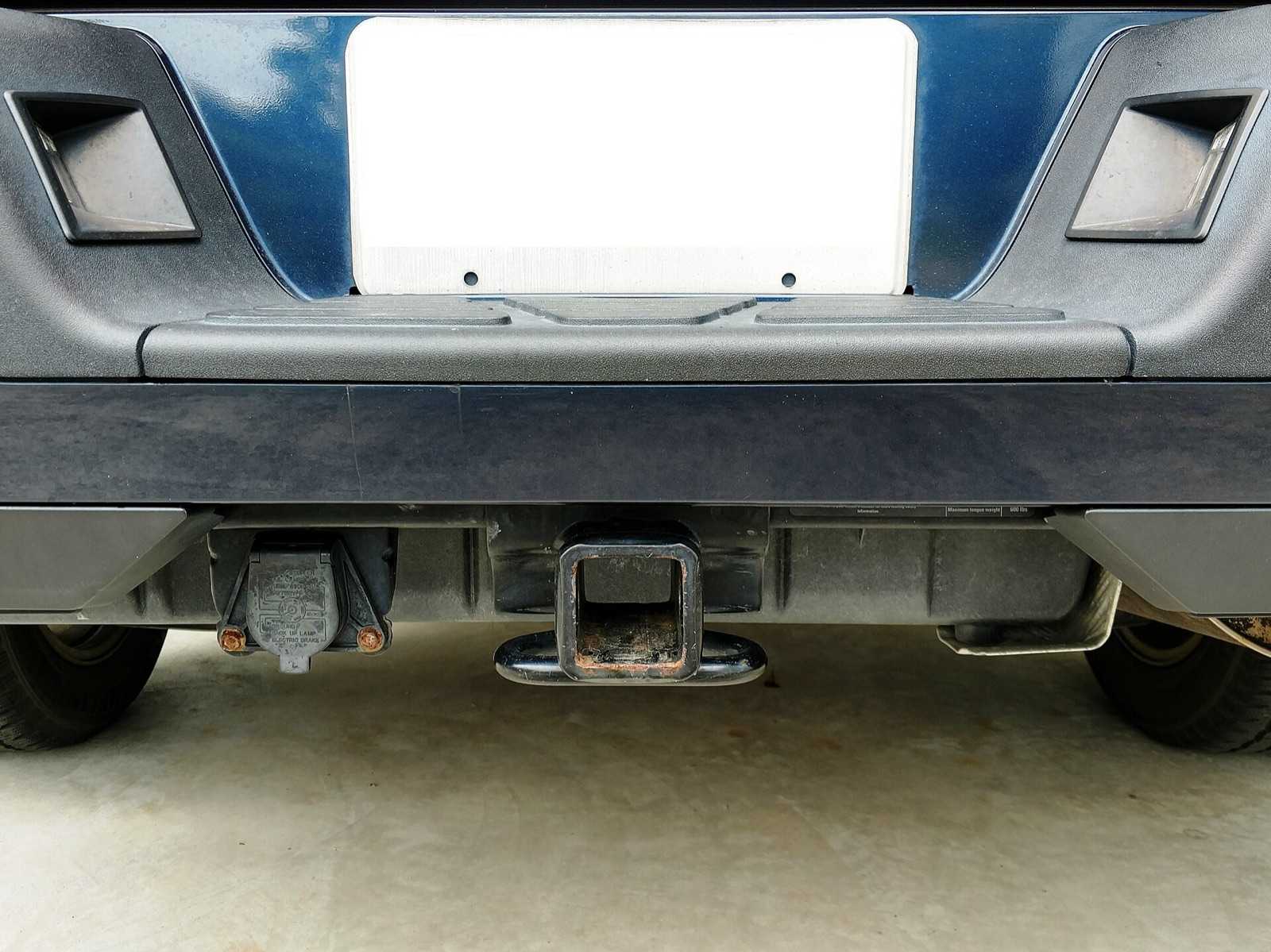
The receiver sticker. Every receiver carries a label with two sets of numbers, something like “Weight Carrying: 600 lb TW / 6,000 lb GTW” and “Weight Distributing: 1,200 lb TW / 12,000 lb GTW.” The lower numbers apply on a plain ball mount. The higher numbers apply only with a weight distribution hitch installed and tensioned. The ball mount and the ball are also stamped with ratings; the lowest number in the chain is the limit.
The spring bars. WDH bars are sold by tongue weight range (600 to 800 lb, 800 to 1,000 lb, and so on). Equal-i-zer’s installation manual tells you to add any cargo behind the truck’s rear axle to the tongue weight when choosing bars. Bars too light won’t restore the front axle; bars too heavy ride harshly and overstress the A-frame.
Payload. The entire tongue weight counts against the truck’s payload, the number on the yellow door-jamb label. The WDH does not make it go away. A 780 lb tongue plus a 90 lb hitch head and bars plus people and gear is where half-ton trucks run out of room; that math has its own guide, payload, not towing capacity.
Step 6Shifting tongue weight without unloading everything
Tongue weight responds to leverage. Move a weight W a distance D along the trailer, and the tongue weight changes by roughly W × D ÷ L, where L is the distance from the trailer axle center (or the midpoint between tandem axles) to the coupler. On a trailer with L = 15 ft, moving 100 lb from the rear bumper (8 ft behind the axle) to the front pass-through (10 ft ahead of it) is 100 × 18 ÷ 15 = 120 lb more on the tongue.
So the levers that matter are the extremes. When you’re under 10 percent:
- Empty gray and black tanks, which are usually at or behind the axle.
- Get bikes and heavy cargo off the rear bumper and into the truck bed. A two-bike rack with bikes is 80 to 100 lb at the worst possible place.
- Move dense items (tools, canned goods, water jugs) from under the rear bed or dinette to the front pass-through.
- Decide on fresh water based on where your tank is. Ahead of the axle: travel full. Behind: travel empty and fill at the campground.
When you’re over 15 percent or over a receiver rating, run the list backward and look hard at the pass-through. Two 30 lb cylinders, two Group 27s, and a generator up front is 230 lb before the first chair.
Symptom → likely cause
| What you see | Most likely | Check |
|---|---|---|
| Sway when passed by trucks or in crosswind, worse above 60 mph | Tongue weight under 10 percent | CAT scale three-weigh; rear bumper cargo; gray/black tanks full |
| Sway only when the fresh tank is full | Fresh tank behind the axle | Locate tank; travel empty |
| Truck rear squats, headlights aim high, steering light | Tongue heavy or WDH bars not tensioned enough | Weigh-in 3 steer axle vs. weigh-in 1 |
| Truck and trailer porpoise over bumps | Bars over-tensioned or too stiff | Bar rating vs. measured tongue weight |
| Tongue scale reads well under CAT number | Measured nose-high or nose-low, or bars still attached | Level trailer, coupler at ride height, bars off |
Stop and fix the setup before you measure if: the trailer wheels are not chocked on both sides; you are on a slope; the tongue jack is on soft ground; or any method puts you under the A-frame or coupler. Never put any part of your body under a tongue supported only by the jack or by a scale. If you need to be under the trailer, use rated jack stands on the frame, on solid ground, with the wheels still chocked. Spring bars under tension can snap a bracket lever back at you; release them the way the hitch manual says, with the tongue jacked to unload them first.
Parts and tools mentioned
- CAT scale (truck stops; Weigh My Truck app for reweighs)
- Sherline LM-1000 or LM-2000 hydraulic tongue weight scale
- Weigh Safe ball mount with built-in tongue weight gauge
- Bathroom scale (300 to 400 lb), 2x4 or steel pipe beam, pipe fulcrum, blocks, tape measure
- Wheel chocks, two per wheel, and rated jack stands if you go under the frame
- Weight distribution hitch spring bars matched to measured tongue weight
- Tongue weight calculator
Questions people ask next
Does a weight distribution hitch reduce tongue weight? No. It moves some of the load the ball is carrying to the truck’s front axle and the trailer’s axles by levering the two frames. Tongue weight is set by how the trailer is loaded. For payload and receiver-rating purposes, use the bars-off number.
Should I measure with the fresh tank full or empty? Measure the way you tow. If you do both, measure both; on a 40 gal tank 6 ft behind the axle of a 15 ft trailer the difference is about 130 lb.
Why does the brochure’s hitch weight differ so much from what I measured? Manufacturers weigh the base trailer with no propane, no battery, no water, and no options, and some weigh the lightest floorplan variant. Propane, batteries, and a loaded pass-through can be 300 lb or more, and all of it rides on the tongue.
Photos

Manuals and references consulted
- SAE J2807 Performance Requirements for Determining Tow-Vehicle Gross Combination Weight Rating and Trailer Weight Rating
- Sherline LM-1000 / LM-2000 Trailer Tongue Weight Scale instructions
- Weigh Safe hitch owner's manual (tongue weight gauge procedure)
- Equal-i-zer and Reese weight distribution hitch installation manuals (spring bar selection)
- DOT propane cylinder tare weight (TW) collar markings
- CAT Scale Company weigh procedure and reweigh policy