How Much Propane Does an RV Use? BTU Math for the Furnace, Fridge, Water Heater, and Stove

Propane runtime math
- Weigh the cylinder 21,548 BTU per lb Gauge reads pressure only
- Read appliance BTU/h Data plate rating
- Estimate duty cycle Furnace 15-60% by temp Guessing high or low
- Multiply, divide by 21,548 lb per day
- Add every appliance Furnace dominates cold
- Divide tank by daily use Days remaining Cold tank can't vaporize
Propane days-left calculator
Tank size, appliances, and outside temperature in; days of propane out.
Open the calculator →Watch it done
Videos are from the channels named, not Chock & Level. Where a video and your manual disagree, follow the manual. Playing a video loads YouTube, which sets its own cookies.
Every propane appliance in the trailer has a BTU/h input rating on its data plate, and a pound of propane holds a fixed number of BTU. Multiply rating by hours of actual burn time, divide by what’s in the tank, and you know how long the tank lasts. The arithmetic is easy. The part that takes judgment is burn time, because the furnace cycles and the stove runs for minutes, not hours.
This guide gives the energy content of propane, the spec ratings for the common appliances, and realistic duty cycles with the assumptions stated, then works two examples: a summer week and a freezing week. The propane runtime calculator at /tools/propane-runtime-calculator/ does the same math for your own numbers.
Quick answer. A 20 lb cylinder holds about 430,000 BTU. In summer (fridge, water heater, stove) a trailer uses roughly 2 to 2.5 lb a day, so one cylinder lasts a week or more. Below freezing, a 30,000 BTU/h furnace at a 40 percent duty cycle burns about 13 lb a day by itself, which empties a 20 lb cylinder in about a day and a half. The furnace is the whole story in cold weather.
What’s in the tank
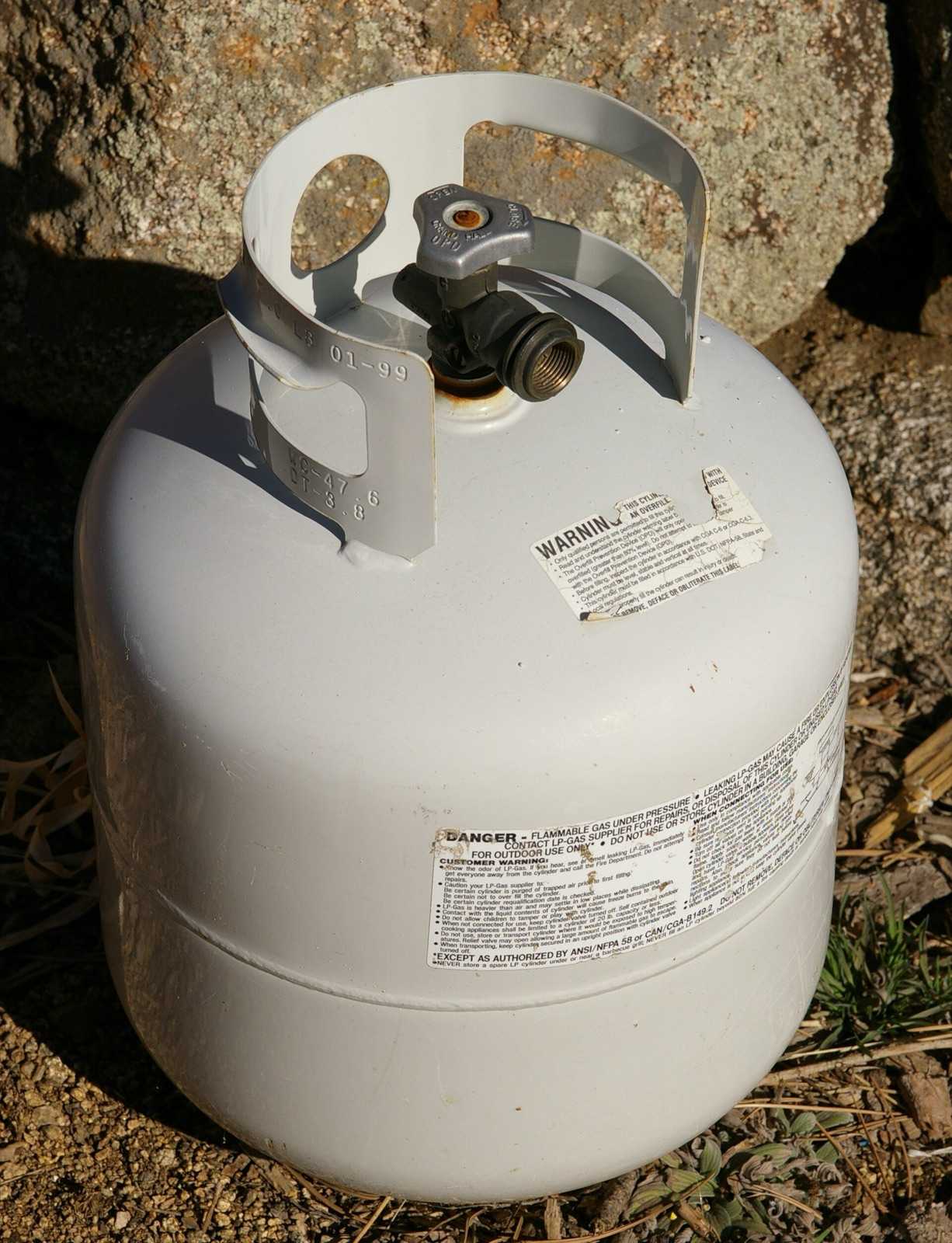
Propane energy content is close to constant: 91,500 BTU per gallon, and a gallon weighs 4.24 lb, so 21,548 BTU per lb. Cylinders are sold by the weight of propane they’re rated to hold, which by the 80 percent fill rule is less than the water capacity stamped on the collar.
| Cylinder | Propane at full fill | Gallons | Energy |
|---|---|---|---|
| 20 lb (the grill size) | 20 lb | about 4.6-4.7 | about 430,000 BTU |
| 30 lb (common dual tongue tanks) | 30 lb | about 7 | about 645,000 BTU |
| 40 lb | 40 lb | about 9.4 | about 860,000 BTU |
An exchange cylinder is often filled to 15 lb rather than 20; read the label. The only accurate gauge for a DOT cylinder is a scale: weigh it, subtract the tare weight stamped on the collar (TW, typically 17 to 18 lb for a 20 lb cylinder), and the remainder is propane. Pressure gauges on the pigtail read vapor pressure, which depends on temperature and barely changes until the tank is nearly empty.
Appliance ratings
These are input ratings from manufacturer spec sheets, the BTU/h the appliance burns while the flame is on. Yours is on the data plate.
| Appliance | Typical rating (BTU/h) | Propane per hour of flame |
|---|---|---|
| Furnace, Suburban NT/SF and Atwood 8500 series | 16,000 / 20,000 / 25,000 / 30,000 / 35,000 / 40,000 | 0.74 to 1.86 lb |
| Absorption fridge, Dometic RM and Norcold N series | about 1,500 (some larger units to 2,000) | about 0.07 lb |
| Water heater, 6 gal Atwood GC6AA | 8,800 | 0.41 lb |
| Water heater, 6 gal Suburban SW6DE | 12,000 | 0.56 lb |
| Water heater, 10 gal Atwood GC10A / Suburban SW10DE | 10,000 / 12,000 | 0.46 / 0.56 lb |
| Stove burner, each | 5,200 to 9,000 (one large, two or three small) | 0.24 to 0.42 lb |
| Oven | 7,000 to 9,000 | 0.32 to 0.42 lb |
| Portable grill (Weber Q1200 class) | 8,500 | 0.39 lb |
| Griddle, 17 in two-burner (Blackstone class) | 12,000 to 15,000 | 0.56 to 0.70 lb |
| Catalytic heater, Camco Olympian Wave 3 / 6 / 8 | 1,600-3,000 / 3,200-6,000 / 4,200-8,000 | 0.07 to 0.37 lb |
| Blue flame portable, Mr. Heater Buddy / Big Buddy | 4,000-9,000 / 4,000-18,000 | 0.19 to 0.84 lb |
The right-hand column is rating divided by 21,548. Keep it in mind for the rest of the article: a 30,000 BTU/h furnace burns about 1.4 lb for every hour the flame is actually on.
The furnace, and why duty cycle is everything
The furnace flame is on only while the thermostat is calling, and how much of the day that is depends on outside temperature, how well the trailer is insulated, the inside setpoint, wind, and whether the trailer is skirted. The table below is a starting estimate, not a measurement.
Assumptions: 25 to 30 ft travel trailer with stock single-pane windows and no skirting, thermostat at 68°F, moderate wind, furnace sized correctly for the trailer. A well-insulated four-season rig will do better; a slide-heavy rig with ducts in the floor will do worse.
| Outside temperature | Estimated duty cycle | 20,000 BTU/h furnace, per day | 30,000 BTU/h furnace, per day | 35,000 BTU/h furnace, per day |
|---|---|---|---|---|
| 50°F | 15% | 72,000 BTU, 3.3 lb | 108,000 BTU, 5.0 lb | 126,000 BTU, 5.8 lb |
| 40°F | 20% | 96,000 BTU, 4.5 lb | 144,000 BTU, 6.7 lb | 168,000 BTU, 7.8 lb |
| 30°F | 30% | 144,000 BTU, 6.7 lb | 216,000 BTU, 10.0 lb | 252,000 BTU, 11.7 lb |
| 20°F | 40% | 192,000 BTU, 8.9 lb | 288,000 BTU, 13.4 lb | 336,000 BTU, 15.6 lb |
| 10°F | 50% | 240,000 BTU, 11.1 lb | 360,000 BTU, 16.7 lb | 420,000 BTU, 19.5 lb |
| 0°F | 60% | 288,000 BTU, 13.4 lb | 432,000 BTU, 20.0 lb | 504,000 BTU, 23.4 lb |
Per day means 24 hours. Math: rating × duty cycle × 24, then divide by 21,548 for pounds. A 30,000 BTU/h furnace at 20°F uses a 20 lb cylinder in about a day and a half, or a 30 lb cylinder in a little over two days. That matches what owners report for winter camping in a stock trailer, which is as much validation as an estimate like this gets.
Two things reduce it that aren’t on the table: dropping the setpoint to 60°F at night takes a noticeable bite out of duty cycle, and a catalytic or blue-flame heater at 3,000 to 6,000 BTU/h can hold a small trailer above 45°F with a fraction of the furnace’s propane and none of its 12 V blower load. Those heaters consume oxygen from the living space and need a window cracked and a working CO detector; follow the manufacturer’s ventilation requirement.
The fridge
An absorption fridge’s burner is rated around 1,500 BTU/h, and it cycles. In mild weather it runs perhaps 50 to 70 percent of the time; in 95°F heat with sun on the vent side, close to 100 percent. That works out to roughly 1 to 1.5 lb per day, or about 36,000 BTU at full-time running. Over a week, 7 to 10 lb.
Larger four-door units (Norcold 1200 series, Dometic RM1350) are rated higher, closer to 2,000 BTU/h, and track the top of that range. Twelve-volt compressor fridges use no propane at all, which is part of why the industry is moving to them.
The water heater
Water heater ratings are 8,800 to 12,000 BTU/h input, and a 6 gal tank recovers from cold in about 20 to 30 minutes of flame. The daily run time depends on how many showers and how much dishwashing. Typical figures: a couple taking short showers and washing dishes runs the burner 1 to 1.5 hours a day in total, including the reheats after each draw and standby losses overnight.
- Suburban SW6DE at 12,000 BTU/h × 1.25 h = 15,000 BTU, about 0.7 lb a day.
- Atwood GC6AA at 8,800 BTU/h × 1.25 h = 11,000 BTU, about 0.5 lb a day. The Atwood recovers more slowly, not more cheaply; same hot water takes about the same BTU either way.
Switching the heater off between uses and running it 30 minutes before a shower roughly halves that. On shore power, the 120 V element (1,440 W on most 6 gal units) does the same job for free.
The stove, oven, and grill
A three-burner RV range typically has one 9,000 BTU/h burner and two at 5,200 to 6,500. Realistic cooking: two burners for 20 to 30 minutes twice a day, say 45 minutes of combined burner time at an average 7,000 BTU/h, is about 5,000 BTU or 0.25 lb a day. The oven at 7,000 to 9,000 BTU/h adds 0.35 to 0.4 lb per hour of baking. A Weber Q1200 on the trailer’s quick-connect burns 8,500 BTU/h, about 0.4 lb per hour of grilling. Cooking is a rounding error next to the furnace.
Generators
Onan’s LP generators are rated by the spec sheet in gallons per hour at half and full load, and the figures are worth knowing because they’re large. From the Cummins Onan spec sheets (verify against your model’s sheet):
- RV QG 2500 LP (2.5 kW): roughly 0.35 to 0.4 gal/h at half load, 0.5 to 0.55 gal/h at full load. That’s 1.5 to 2.3 lb per hour.
- RV QG 4000 LP (3.6 kW on propane): roughly 0.5 gal/h at half load, 0.8 gal/h at full load. That’s 2.1 to 3.4 lb per hour.
Running a rooftop air conditioner for 8 hours on the 4000 at half load uses around 4 gal, nearly a whole 20 lb cylinder, in one day. A propane generator is a convenience for occasional use, not a plan for a week of air conditioning.
Worked example: a summer week
Couple, 25 ft trailer, no furnace use, 85°F days, fridge on propane, Suburban SW6DE, cooking twice a day.
| Load | Per day | Per week |
|---|---|---|
| Fridge, 1,500 BTU/h at 80% | 28,800 BTU, 1.3 lb | 9.4 lb |
| Water heater, 12,000 BTU/h × 1.25 h | 15,000 BTU, 0.7 lb | 4.9 lb |
| Stove, 7,000 BTU/h × 0.75 h | 5,250 BTU, 0.25 lb | 1.7 lb |
| Grill, 8,500 BTU/h × 0.5 h, three nights | 0.6 lb | |
| Total | about 2.3 lb | about 16.6 lb |
One 20 lb cylinder covers the week with a few pounds to spare. Two 30 lb cylinders on the tongue cover most of a month.
Worked example: a freezing week
Same couple, same trailer, 30,000 BTU/h Suburban furnace, outside averaging 20°F, thermostat at 68°F by day and 60°F at night.
| Load | Per day | Per week |
|---|---|---|
| Furnace, 30,000 BTU/h at 35% (night setback) | 252,000 BTU, 11.7 lb | 82 lb |
| Fridge, 1,500 BTU/h at 50% (cold outside helps) | 18,000 BTU, 0.8 lb | 5.8 lb |
| Water heater, 12,000 BTU/h × 1.5 h (colder inlet water) | 18,000 BTU, 0.8 lb | 5.8 lb |
| Stove | 5,250 BTU, 0.25 lb | 1.7 lb |
| Total | about 13.5 lb | about 95 lb |
That’s nearly five 20 lb cylinders, or three 30 lb cylinders plus a fill mid-week. Furnace usage dominates by a factor of seven, and every other line could be zero without changing the answer much. The 12 V side matters too: that furnace runs its blower about 8.4 hours a day at 7 to 11 A, which is 60 to 90 Ah of battery per day. The battery runtime guide covers that half.
Cold weather: why the tank can’t keep up
Propane in the cylinder is a liquid, and the appliances burn vapor. The liquid boils to make vapor, and boiling takes heat, which comes from the air around the cylinder through the steel wall where liquid touches it. Cold air, and less liquid touching the wall, means less vapor per hour.
At 70°F a 20 lb cylinder can vaporize propane far faster than any trailer can burn it. At 0°F it can’t. Vapor pressure drops from about 109 psi at 70°F to about 24 psi at 0°F, and the vaporization rate of a half-full 20 lb cylinder at 0°F in still air is in the rough range of 20,000 to 30,000 BTU/h continuous, with published charts disagreeing on the exact figure because wind and fill level move it so much. A 30,000 BTU/h furnace plus a 12,000 BTU/h water heater is 42,000 BTU/h. The cylinder frosts over, pressure sags, the furnace flame goes lazy and drops out, and the forums tell you the regulator is bad.
What helps, in order: a fuller cylinder (more wetted wall), a 30 or 40 lb cylinder for the same reason, and keeping the cylinders out of the wind. An auto-changeover regulator draws from one cylinder at a time, so it doesn’t add vaporization capacity; it only keeps you from running dry at 3 a.m. What doesn’t help: wrapping the cylinder in a blanket, which insulates it from the air it needs heat from. Never apply a flame or an unapproved heater to a cylinder.
Regulator freeze-up
A regulator drops pressure from tank pressure to 11 in water column, and the gas cools as it expands through the orifice. Any moisture in the gas can freeze there. Moisture gets in from a cylinder left open with the valve uncapped, from an overfilled cylinder sending liquid into the regulator, or from a cylinder that has been refilled many times from a wet supply. Frost on the outside of a regulator body on a humid cold morning is normal condensation; a regulator that stops delivering until it thaws has ice inside.
The fix is to have a propane dealer purge the cylinder with methanol or replace it, and to keep the regulator vent pointed down and covered against rain. A regulator past about 15 years, or one that’s been under water, is replaced. There is nothing to adjust on a two-stage RV regulator and no user-serviceable part inside.
Load → daily propane
| Load | Rating | Realistic run time | Propane per day |
|---|---|---|---|
| Furnace, 30,000 BTU/h, 20°F outside | 30,000 BTU/h | 40% | about 13 lb |
| Furnace, 30,000 BTU/h, 40°F outside | 30,000 BTU/h | 20% | about 7 lb |
| Absorption fridge | 1,500 BTU/h | 50-100% | 1-1.5 lb |
| Water heater, 6 gal | 8,800-12,000 BTU/h | 1-1.5 h | 0.5-0.8 lb |
| Stove, two meals | 5,200-9,000 BTU/h each | 45 min total | about 0.25 lb |
| Catalytic heater, Wave 6 on high | 6,000 BTU/h | 10 h | about 2.8 lb |
| Onan 4000 LP, half load | about 0.5 gal/h | 4 h | about 8.5 lb |
Stop and call a certified RV technician or your propane dealer if: you smell propane at the cylinders, regulator, or inside the rig; the regulator vent is plugged or the body has been submerged; a cylinder shows frost in a ring at the liquid line while appliances are starving in weather above freezing (possible overfill or a stuck excess flow valve); or a cylinder is more than 12 years from its stamped manufacture date without a requalification stamp. Never attempt to adjust or open a regulator, heat a cylinder, or transfer propane between cylinders.
Parts and tools mentioned
- Bathroom or luggage scale for weighing cylinders
- Auto-changeover two-stage regulator (Marshall Excelsior and Cavagna are the common OEMs)
- 30 lb DOT cylinders if the tongue frame has room
- Catalytic heater (Camco Olympian Wave 3/6/8) or blue-flame portable (Mr. Heater Buddy series) with the manufacturer’s ventilation requirement
- Propane runtime calculator at /tools/propane-runtime-calculator/
Questions people ask next
How long will a 20 lb propane tank run an RV furnace? Divide 430,000 BTU by the furnace rating for hours of flame: 14 hours for a 30,000 BTU/h furnace, 21 hours for 20,000. At a 40 percent duty cycle (around 20°F outside in a stock trailer) that’s 36 hours of camping for the 30,000 and 54 hours for the 20,000.
How long will a 20 lb tank run an RV fridge? At 1 to 1.5 lb a day, 13 to 20 days. In mild weather with shade on the vent side, closer to three weeks.
Does the inline gauge on the pigtail tell me how much is left? No. It reads vapor pressure, which depends on temperature, not quantity. A cylinder at 70°F reads the same at 90 percent and 10 percent full. Weigh the cylinder.
Why does my furnace work fine in fall and starve in January? Vaporization. A cold, half-empty cylinder can’t boil propane fast enough to feed a 30,000 BTU/h furnace continuously, and pressure sags under load. Fuller cylinders, larger cylinders, and shelter from wind are the fixes.
Is a 30 lb tank worth it over a 20? For cold-weather camping, yes: 50 percent more propane and more wetted wall area for vaporization. Check that the tongue cover and bracket fit a 30; they’re taller and about 18 lb heavier full (roughly 55 lb against 37 lb).
Manuals and references consulted
- Propane Education & Research Council, propane energy content (91,500 BTU/gal, 4.24 lb/gal)
- Suburban Manufacturing NT/SF furnace and SW water heater spec sheets
- Atwood/Dometic Hydro Flame furnace and GC water heater spec sheets
- Dometic RM series refrigerator specifications
- Cummins Onan RV QG 2500 LP and RV QG 4000 LP specification sheets
- Camco Olympian Wave and Mr. Heater Buddy series product specifications