RV Fridge Not Cooling but Freezer Is
The Absorption Fridge Checks (Dometic and Norcold)
Absorption cooling path
- Heat into boiler 1,500 BTU/h or 325 W Dirty burner, open element
- Ammonia vapor rises Off level, blockage
- Condenser sheds heat Needs baffle, airflow Missing baffle, hot ambient
- Liquid drains to freezer Off level, over 3°
- Fins cool fresh food Target 34-40°F Frost, overpacking, seal
- Thermistor reads fins Fallen off, failed
- Absorber recycles ammonia Yellow powder, ammonia smell
Not sure where to start?
Answer one check at a time, in the order the system works. The first "no" is where the fault is, and you jump straight to the step that fixes it.
Watch it done
Videos are from the channels named, not Chock & Level. Where a video and your manual disagree, follow the manual. Playing a video loads YouTube, which sets its own cookies.
The freezer makes ice. The fresh-food section reads 50°F, the milk turns in two days, and the fridge is set as cold as it goes. On an absorption fridge this is the most common cooling complaint, and most of the time the cooling unit is fine. It’s just not getting enough of something: level, airflow across the back, a clean heat source, or an accurate reading from the fins.
In order of likelihood: the rig isn’t level enough, the rear vent path is restricted or the air baffle is missing, the thermistor on the fins has moved or failed, the door seal leaks, the fridge is overpacked, or the heat source (burner or 120 V element) is weak. A failed cooling unit comes last, and it has its own signs.
You need a bubble level, a fridge thermometer, a multimeter, and a flashlight. The checks take an hour or two; confirming a fix takes a day because an absorption fridge responds slowly.
Quick answer. Level the rig, open the lower exterior vent and confirm a baffle directs air up across the condenser (many are missing from the factory), and pull the fridge away from the wall of food so cold air can fall off the fins. Check the thermistor is clipped to a fin and not dangling. If the fresh-food section is still above 40°F after 24 hours, test the thermistor's resistance and the heat source. Yellow powder or an ammonia smell at the back means the cooling unit has failed; stop and call a tech.
How an absorption fridge cools, and why the freezer wins
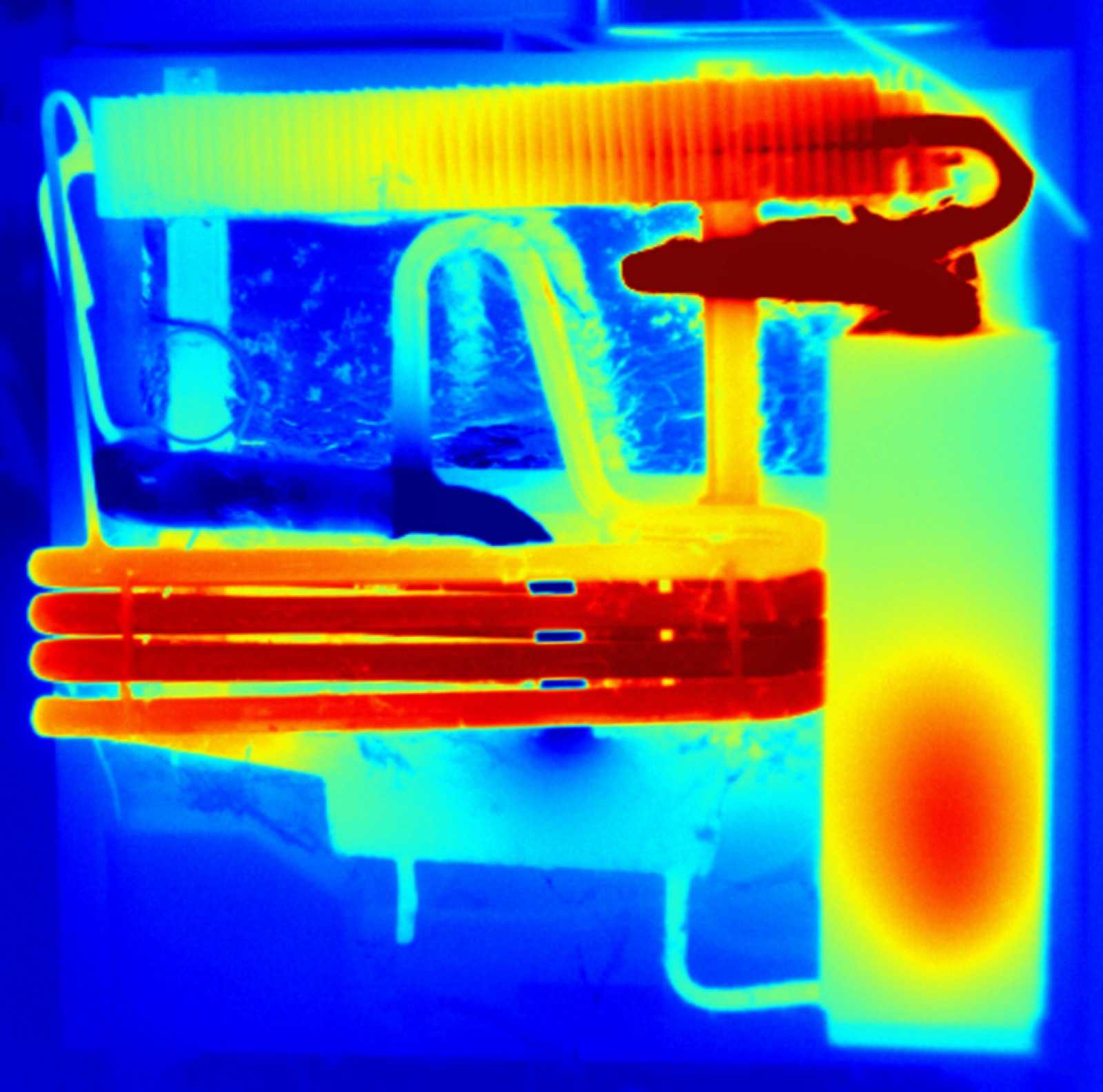
A Dometic or Norcold RV fridge has no compressor. A sealed steel cooling unit on the back holds ammonia, water, and hydrogen, plus sodium chromate as a rust inhibitor. Heat goes into the boiler at the bottom, from a propane flame rated around 1,500 BTU/h or a 120 V element of roughly 325 W (3-way models add a 12 V element). Ammonia boils out of the water, rises as vapor to the condenser fins at the top rear, sheds its heat to outside air, and condenses to liquid.
That liquid drains by gravity into the evaporator. The first coil it reaches is wrapped around the freezer, where the ammonia evaporates into the hydrogen atmosphere and pulls heat out of the box. What’s left flows on to the second evaporator, the fins at the top of the fresh-food compartment. From there the mix drops into the absorber, the water takes the ammonia back, and the cycle repeats.
Two things fall out of that. Gravity does all the moving, which is why level matters: Dometic’s older manuals allow about 3° side to side and 6° front to back, and newer Dometic and Norcold specs are typically tighter, around 3° on either axis. And the freezer is first in line. A cooling unit running at 60 percent capacity will still freeze the freezer and starve the fins below it. A cold freezer and a warm fridge is the signature of a unit that is working, just not well enough.
Targets: fresh food 34°F to 40°F, freezer 0°F to 10°F. A warm fridge takes 8 to 12 hours to pull down and up to 24 hours to stabilize with food in it.
Step 1Level the rig and set a thermometer
Put a bubble level on the freezer floor, side to side and front to back. The old rule from Dometic manuals is that if it’s level enough to sleep comfortably, it’s level enough for the fridge; that’s about 3°, roughly half a bubble. Block or jack until it is.
Set a thermometer on the middle shelf of the fresh-food section, close the door, and leave it 8 hours. A fridge that cools on the road (motion keeps the liquid moving) and warms at a tilted campsite has already told you the answer.
Step 2Open the lower vent and look for the baffle
Pull the exterior lower vent cover. You’re looking at the back of the cooling unit: boiler and burner at the bottom, absorber coils, condenser fins at the top under the roof or upper side vent.
The design relies on a chimney effect. Outside air enters the lower vent, warms against the absorber and condenser, and leaves through the upper vent. For that to work, the installation manual requires a baffle above the condenser that blocks every path for hot air except across the fins and out the upper vent, and it limits the gap between the cooling unit and the wall behind it to about 1 in at the condenser. Open space above or behind the fridge lets hot air recirculate and pool.
- No baffle, or daylight above the fins: fit a sheet-metal or foil-faced foam baffle angled from the wall to the top of the condenser. Missing baffles are a very common factory omission, and fitting one is the highest-return fix on this list.
- Vents painted over, screened with fine mesh, or holding a wasp nest: clear them.
- Ambient above about 90°F: the condenser can’t shed heat and performance drops. Dometic rates most units to a 90°F to 110°F ambient depending on climate class. In hot weather the fresh-food section suffers first. The fix is two 120 mm 12 V fans (around 0.2 A each) zip-tied below the condenser fins, blowing up, on a thermal snap switch. Aftermarket kits do the same thing.
Step 3Door seal, with a dollar bill
Close the fresh-food door on a dollar bill and pull. It should drag firmly. Work the full perimeter; the top hinge corner and the handle side are where seals shrink and doors sag. A bill that slides out freely means warm air is leaking in continuously and the fins frost over trying to keep up. Adjust a sagging hinge, reshape a shrunk seal with a hair dryer, or replace it. Check the freezer door the same way.
Step 4Overpacking and airflow inside the box
Cold air leaves the fins by falling. Groceries packed against the fins or stacked to the top shelf keep the top cold and the bottom and door shelves warm. Leave an inch of open space in front of and below the fins. A small battery-powered fridge fan on the lower shelf, blowing up, evens out the box by several degrees.
Step 5Fins, frost, and the drip tube
The fins should be cold with at most a thin frost. A layer over about 1/8 in insulates them and the fridge warms up while the freezer stays cold. Shut the fridge off, prop the doors, and defrost fully. Then check the drip tray under the fins: it drains through a tube out the back to an evaporation cup on the boiler housing. A clogged tube leaves water pooling under the fins, which freezes and blocks airflow. Clear it with a pipe cleaner.
Step 6Thermistor position and resistance
On Dometic RM-series and most Norcold models, a thermistor clipped to one of the fins is the only temperature sensor the board has, and its position sets the fridge temperature. If it has fallen off and is dangling, the board thinks the box is warm and runs flat out, which over-freezes the fins and can present as a warm fridge with a frosted evaporator.
Find it: a small cylinder on a wire, clipped to a fin, usually toward one side. The fins are coldest at the top where the ammonia enters, so the clip’s height changes what it reports. The common adjustment on Dometic units is to slide the clip down toward the warmer lower part of the fin to make the compartment colder, and up to make it warmer. Move it a little, then give it 24 hours with a thermometer before moving it again.
Test it: unplug the thermistor from the board (behind the lower vent, or behind the interior control panel on some models) and read resistance.
- It’s an NTC thermistor, so resistance rises as it cools. Read it at room temperature, then in a cup of ice water for two minutes. The cold reading should be substantially higher, typically two to three times the room reading. Dometic and Norcold service manuals print a resistance-versus-temperature table; use yours for exact numbers.
- Infinite (open) or near 0 Ω (shorted): failed. Replace it.
- Reads plausibly and changes with temperature: it’s working, and position is what to adjust.
Step 7Check the heat source on each mode
Run the fridge a few hours on propane, then a few hours on 120 V, thermometer in place. If one mode cools and the other doesn’t, the weak mode’s heat source is the problem, not the cooling unit.
On propane. Look at the flame through the inspection port at the lower vent. You want a steady blue flame filling the burner. A yellow, lazy, or lifting flame means a dirty burner, a partly blocked orifice, or rust flakes from the flue sitting on the burner. Shut off the gas, pull the burner assembly, brush it, and blow it out with compressed air. Clean the orifice with alcohol and air only, never a wire. Pull the spiral baffle out of the flue and knock the rust scale out of the flue tube while you’re there. A fridge that cools on 120 V and not on gas almost always has a dirty burner or flue.
On 120 V. The element sits in a pocket on the boiler. With shore power unplugged and the inverter off, disconnect the element’s two leads and measure resistance across them. A 325 W, 120 V element calculates to about 44 Ω (120² ÷ 325); the 40 to 50 Ω ballpark is normal for elements in that power range. Larger Norcold units with two elements get tested one at a time. Infinite resistance means the element is open and has failed; a few ohms, or any reading to the sheath, means it’s shorted. An element that tests fine but doesn’t heat is a board relay problem, which is a live-voltage diagnosis and belongs in the stop box.
Step 8Fault codes
Newer Dometic models with a digital display show “no co” (no cooling) when the thermistor doesn’t report falling temperature within the board’s expected window. That can be a bad thermistor, a heat source that isn’t heating, or a cooling unit that has quit; work steps 6 and 7 before assuming the worst. Norcold displays “no FL” for no flame on gas and “no AC” or “no DC” for a missing supply. Older boards blink an LED; the service manual has the chart.
Step 9Signs of a failed cooling unit
If the rig is level, the vents are clear with a baffle in place, the thermistor tests and sits correctly, the flame is blue and the element reads 44 Ω, and after 24 hours the freezer is cold and the fridge is not, the cooling unit itself may be partly blocked or leaking.
- Yellow or yellow-green powder at a tube joint, around the boiler, or dusted on the absorber coils is dried sodium chromate that leaked out with the ammonia. The unit is done.
- Ammonia smell at the back or inside the box, sharp like cat urine. Same conclusion.
- Boiler hot, condenser barely warm after two hours running level. Heat is going in and nothing is circulating. That’s a blockage.
- The gurgling or percolating sound it used to make has stopped.
The “burp” and what it actually does
You’ll read advice to pull the fridge, turn it upside down for a day or two, and reinstall it. In a unit that has run off level or sat unused for years, liquid can settle where it blocks flow, and partially crystallized rust inhibitor can lodge in the narrow percolator tube. Inverting the unit lets gravity redistribute the liquid and sometimes dislodges a soft blockage.
It can’t fix a leak, and a unit whose inhibitor has broken down from years of overheating blocks again within weeks. It is a last-ditch attempt on a unit that’s already written off, not maintenance, and not a substitute for checking the baffle and the thermistor.
Norcold recall and the high-temperature sensor
Norcold 1200 and 1210 series and several N6 and N8 models were recalled (multiple NHTSA campaigns from the early 2000s onward) to add a high-temperature sensor on the boiler tube. It cuts power to the control when the boiler overheats, which is what happens when a cooling unit is blocked or has leaked and the heat has nowhere to go. Check your serial number against the recall at Norcold or NHTSA.
If a fridge with the kit stops cooling and shows no fault, the sensor may have opened. On many kits it is a one-time device that a tech replaces, and its tripping is a warning about the cooling unit, not a nuisance. Do not jumper it or remove it. The fires it was added to prevent are the reason the recall exists.
Symptom → likely cause
| What you see | Most likely | Check |
|---|---|---|
| Freezer cold, fridge 45-55°F, worse at the campsite than on the road | Off level | Bubble level on freezer floor |
| Fine in the morning, warm by late afternoon | Rear ventilation, missing baffle, hot ambient | Lower vent, baffle, add fans |
| Fins frosted over, fridge warm | Door seal leak or thermistor off the fin | Dollar bill test, thermistor clip |
| Cools on 120 V, not on gas | Dirty burner, orifice, or flue | Flame color, clean burner |
| Cools on gas, not on 120 V | Heating element open | 40-50 Ω across the element |
| Display reads “no co” | Thermistor, heat source, or cooling unit | Steps 6, 7, 9 |
| Yellow powder or ammonia smell at the back | Failed cooling unit | Stop; replace |
Stop and call a certified RV technician if: you smell ammonia anywhere near the fridge (shut it off, open windows and vents, and keep the rig ventilated until the smell is gone); you see yellow powder at the cooling unit; the flame is still yellow after you've cleaned the burner; you smell propane at the burner; or you see scorching behind the fridge. Any check that means measuring 120 V at the element or board with shore power connected is a tech's job unless you are trained for live work. Unplug shore power and shut off the inverter before touching element wiring.
Parts and tools mentioned
- Bubble level and a fridge thermometer
- Digital multimeter with ohms
- Sheet metal or foil-faced foam board for a condenser baffle
- Two 120 mm 12 V fans and a thermal snap switch, or an aftermarket fan kit
- Replacement thermistor, door gasket, or 120 V element matched to your model
- Soft brush, compressed air, pipe cleaner, isopropyl alcohol
Questions people ask next
Why is the freezer fine if the cooling unit is failing? The freezer evaporator is first in the ammonia’s path, so it gets whatever cooling the unit can produce. The fresh-food fins are downstream and get what’s left. A unit at partial capacity freezes the freezer and starves the fridge.
Does moving the thermistor up or down make the fridge colder? On Dometic units the usual advice is that sliding the clip down the fin makes the compartment colder and up makes it warmer, because the fin is coldest at the top. Move it a little, wait 24 hours, and read a thermometer before moving it again.
Is it worth adding fans behind the fridge? If you camp anywhere hot, yes. Two 12 V fans on the condenser draw under a quarter amp each and often make a 10°F difference on a hot afternoon. Fit the baffle first; fans can’t fix a missing baffle.
Photos

Manuals and references consulted
- Dometic RM2000/RM2600/RM2800 Series Installation and Operating Instructions (leveling, ventilation, and clearance requirements)
- Dometic Americana and DM Series Service Manual (thermistor placement and fault codes)
- Norcold N6/N8 and 1200 Series Installation and Owner's Manuals
- Norcold High Temperature Sensor recall notices (NHTSA campaigns covering 1200/1210 and N-series units)