RV Water Pump Won't Shut Off
Empty Tank, Open Fixture, Leak Hunt, and the Pressure Switch
Nonstop pump, work order
- Tank has water Gauge lying, nose-high
- Fixtures all closed Outside shower, toilet
- Bypass valves normal Plug out, siphon open
- Outside is dry Drains, inlet, relief valve
- Underbelly is dry Split line, freeze crack
- Suction side tight Strainer O-ring, clamps
- Pump reaches cut-off 45-55 psi spec Diaphragm, cracked head
- Switch opens, pump stops Switch welded, set high
Not sure where to start?
Answer one check at a time, in the order the system works. The first "no" is where the fault is, and you jump straight to the step that fixes it.
Watch it done
Videos are from the channels named, not Chock & Level. Where a video and your manual disagree, follow the manual. Playing a video loads YouTube, which sets its own cookies.
You turn the pump switch on, close everything, and it keeps running. A minute, five minutes, until you shut it off. A demand pump is supposed to build pressure and stop. If it never stops, it either isn’t building pressure, or the water is going somewhere as fast as the pump makes it.
This is a different problem from a pump that pulses or cycles with everything closed. Cycling means a slow leak. Running nonstop means a big leak, an empty tank, or a pump that can’t make pressure. The pulsing and cycling guide covers the slow version and the accumulator.
In order of how often it’s the cause: the fresh tank is empty, a fixture or valve is open, the winterizing bypass is set wrong, a low-point drain is open or a line has split, the pump is sucking air, and last the pressure switch or the pump itself. You need a flashlight, paper towels, and ideally a cheap pressure gauge that threads onto a hose fitting. Most people find it in the first 20 minutes.
Quick answer. Look in the fresh tank with a flashlight or fill it; don't trust the gauge. Open a faucet: no water or sputtering means the pump is running dry or sucking air. Water at the faucet means it's going somewhere else: walk the outside for running water at low-point drains, the city inlet, the relief valve, and the underbelly, then check every fixture and the bypass valves. Only when everything is closed, dry, and the tank is full do you suspect the pressure switch.
How a demand pump decides to stop
A diaphragm pump (Shurflo 4008 or 2088, Flojet Triplex, Seaflo 42-Series, Remco) has a pressure switch on the pump head. Open a faucet, pressure drops, the switch closes, the motor runs. Close the faucet, pressure rises to the switch’s cut-off, the motor stops. The pump stops only when the outlet reaches cut-off pressure.
Spec-sheet cut-off pressures for common pumps:
| Pump | Cut-off (spec sheet) | Flow (spec) |
|---|---|---|
| Shurflo 4008-101-E65 Revolution | 55 psi | 3.0 gal/min |
| Shurflo 4008, other variants | 45 to 55 psi depending on suffix | 3.0 gal/min |
| Shurflo 2088-554-144 Classic | 45 psi | 3.5 gal/min |
| Flojet 03526-144A Triplex | 50 psi | 2.9 gal/min |
| Seaflo SFDP1-030-055-41 | 55 psi | 3.0 gal/min |
The label on your pump is the final word. Shurflo has sold 4008 variants at more than one pressure, so verify yours rather than trusting a forum figure.
Three things stop a pump from reaching cut-off: no water to pump, water leaving as fast as it’s pumped, or a pump that can’t make the pressure. Each step below rules one out.
Step 1Is the fresh tank actually empty?
RV tank gauges read through probes in the tank wall, and fresh-tank probes foul and lie less than black-tank ones, but they still lie. A gauge that says 2/3 on a dry tank is common.
Open a faucet. If no water comes out, or it spits air and stops, the pump is running dry. Look in the fill opening with a flashlight, or simply add 10 gal and try again. If you’re parked nose-high, the tank outlet may be above the remaining water on a tank that is a third full; level the rig.
Running a diaphragm pump dry for a few minutes won’t usually kill it, but don’t leave it running for hours. That’s one reason to keep the pump switch off when you leave the rig.
Step 2Open fixtures, including the ones you forget
If the faucet gets a full stream, the pump is making water and losing it somewhere. Start inside.
- Every kitchen and bath faucet, hot and cold.
- The shower valve and the shower head’s trickle valve. A handheld head with its button closed can still have the valve open behind it.
- The outside shower in its exterior box. A child opens it, the head hangs closed in the box, the valve stays open, and water runs out the box drain.
- The toilet water valve. A Dometic 310 or Thetford Aqua-Magic V with a valve stuck open runs water into the bowl continuously. Look in the bowl. A big failure here runs the pump nonstop; a small one only cycles it. See the toilet guide.
- Washer hookup, ice maker line, or a black tank flush connection with a failed check valve.
The fixture test
Close every fixture. Turn the pump on. If it still runs, go outside and close the next suspects one at a time: if your rig has shut-off valves at the toilet or under the sinks, close those. Each time the pump stops, the last valve you closed was feeding the leak. On rigs with a manifold (Lippert and others put a multi-port manifold in a bay with a valve per branch), close the branches one at a time and watch the pump. That one test can cut an hour of crawling to five minutes.
Step 3Winterizing bypass valves left wrong
The water heater bypass is usually one, two, or three valves behind the heater. Most rigs also have a pump winterizing valve or a siphon hose on the pump inlet. Set wrong in spring, they cause three different nonstop-pump problems:
- Water heater drain plug or anode rod still out after winterizing, bypass back in normal. The pump fills the tank and the water runs out the drain hole at the exterior door. Easy to see.
- Pump winterizing valve open to the siphon hose. The pump pulls air or an empty jug of antifreeze instead of tank water. It runs and runs with little flow.
- A three-valve bypass with one valve wrong. Water can circulate from the outlet back toward the inlet, and on some layouts the pump never sees cut-off.
Set them as described in the winterizing guide: bypass valves to normal, siphon valve closed to the tank, water heater drain plug or anode reinstalled. Then bleed air at the farthest faucet until the flow is steady.
Step 4Walk the outside: drains, inlet, relief valve
Go outside with the pump running and look and listen.
- Low-point drains. Two small valves or caps, hot and cold, under the trailer near the axles or behind an access panel. Open drains are the most common winterizing leftover, and the water runs right onto the ground.
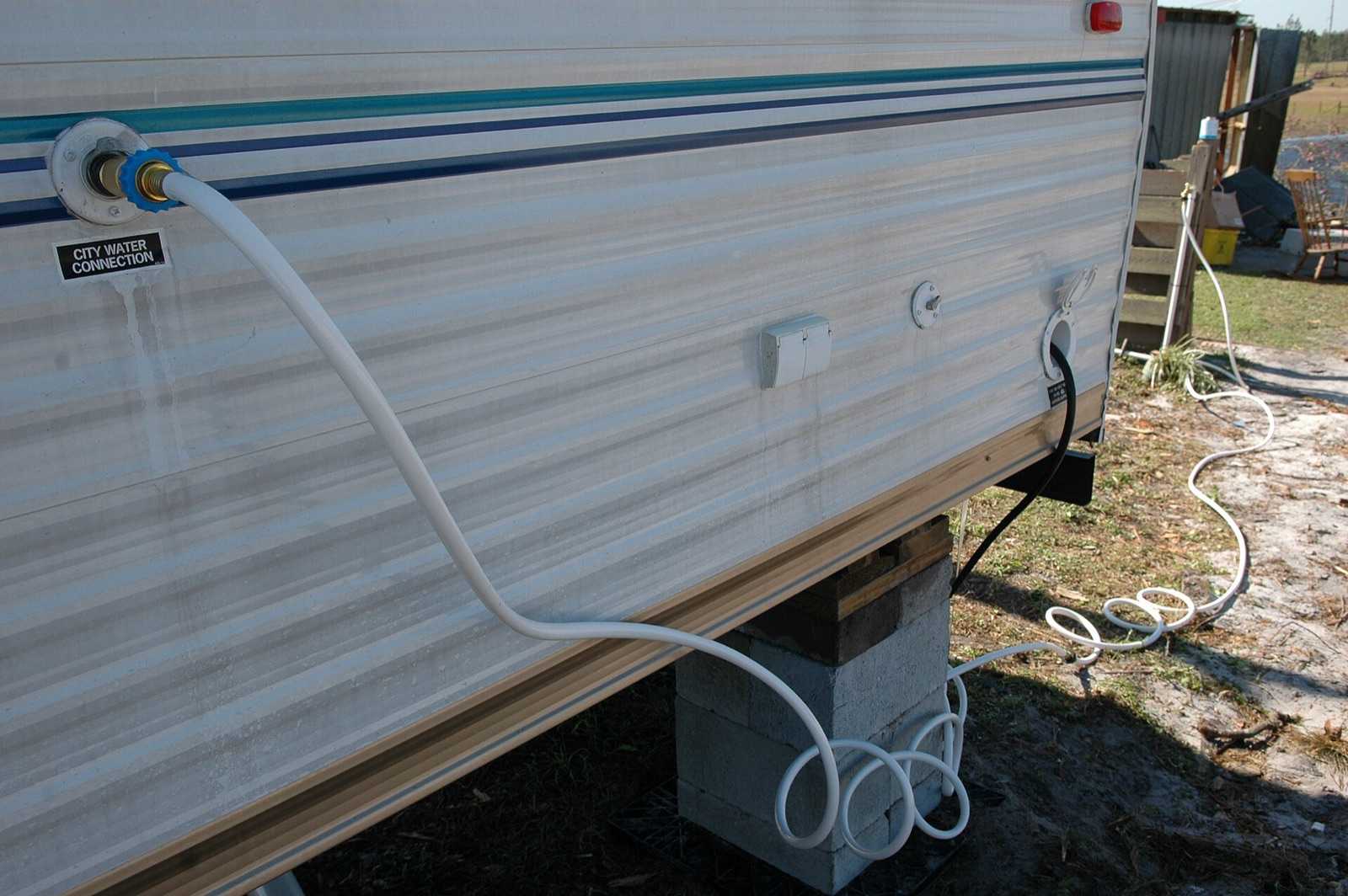
- City water inlet. A spring check valve behind the hose fitting stops pump pressure from pushing water out the inlet. When it fails badly, water pours out the city fitting while the pump runs. Cap the inlet with a hose cap as a test; if the pump stops, replace the inlet check valve.
- Water heater relief valve. The lever valve on the heater, outside behind the door. A steady stream from it while the pump runs means it is passing pressure. A brief weep after heating is a different, normal-ish issue covered in the drain and anode guide. A valve that runs steadily at cold pressure has failed or has debris on the seat. Lift and snap the lever once to flush it; if it keeps running, replace it with the correct rating (typically 150 psi / 210 °F on RV heaters). Never plug it.
Step 5The underbelly and the split line
If nothing is running outside and the fixtures are closed, the leak is inside a wall, under a cabinet, or in the underbelly. Freeze damage is the classic cause: a PEX line splits or a plastic fitting cracks where water was left in a low spot.
Walk under the trailer with a flashlight and look for drips along the coroplast underbelly, especially near the low-point drains, the fresh tank, and the water heater. Press up gently on the coroplast; a sagging, heavy panel is full of water. Wet soil under the rig after the pump has run a few minutes is a giveaway even when you can’t see a drip.
Where the water went
When nothing shows outside, check inside, in this order:
- Under the kitchen and bath sinks. Fittings at the faucet supply lines and drain traps.
- Behind and below the shower. Pull the access panel if there is one; the shower valve body and its fittings are a common freeze crack.
- Behind the fridge if it has an ice maker or water line.
- Around the water heater on the inside, at the bypass valves and the inlet and outlet fittings.
- The pump bay itself, at the strainer and the outlet fitting.
- The underbelly, after all the above, by dropping a coroplast panel near the wet spot.
A dry paper towel wrapped around each suspect fitting finds drips the flashlight misses. For leaks you can’t find this way, the camper water leak guide covers the slower methods.
Step 6Pump sucking air on the suction side
If the faucet sputters, the flow is weak, and the pump sounds hollow and fast, it may be pulling air instead of water. Nothing drips on the suction side, because it’s under vacuum.
- Tighten the clear strainer bowl by hand and check its O-ring. A flattened or missing O-ring is the usual culprit.
- Check every hose clamp and barb from the tank outlet to the pump inlet.
- Check the tank outlet fitting; plastic barbs threaded into plastic tanks loosen over years.
- Clean the strainer screen. A clogged screen starves the pump and it can’t make cut-off pressure.
Step 7The pump itself: check valve, diaphragm, cracked head
If the tank is full, nothing leaks, the suction side is tight, and the pump still runs, test whether it can make pressure.
Thread a pressure gauge onto an outside shower or a hose bib adapter, close everything else, and run the pump.
- Gauge climbs to the label cut-off and the pump keeps running: the pressure switch has failed closed or drifted high. Step 8.
- Gauge stalls well below cut-off: the pump can’t make its rated pressure. A torn diaphragm, worn valves, or a cracked pump head (common after a freeze, since water left in the head expands) are the causes. Look at the pump head for a hairline crack and water weeping from the housing seams. The pump’s internal check valve failing doesn’t usually cause nonstop running, but a damaged valve assembly can. Shurflo sells upper housing and diaphragm kits for the 4008; on a budget pump, replace the whole pump.
- Gauge reads near zero: pump isn’t moving water. Back to steps 1 and 6.
Step 8The pressure switch
The switch is a small microswitch under a cover on the pump head, closed by a diaphragm pushed by water pressure. It fails two ways: contacts weld closed, or the set point drifts.
Shurflo 4008 and similar pumps have a small adjustment screw on the switch. Clockwise raises cut-off; counterclockwise lowers it. The range is only a few psi.
Here’s why cranking it is the wrong instinct: if the cut-off is set above what the pump can deliver, the pump never reaches it and runs forever. That’s exactly the symptom you have. If the screw has been turned in, back it out an eighth of a turn at a time and retest with the gauge. If the gauge reads the label cut-off and the pump still runs, or a full turn changes nothing, replace the switch. It’s a separate part for most Shurflo and Flojet pumps.
To confirm a welded switch with the meter, disconnect the pump’s power, unplug the switch leads, and check continuity across the switch at zero water pressure (it should be closed), then with the system at full pressure (it should open). Closed at full pressure means it has failed.
Symptom → likely cause
| What you see | Most likely | Check |
|---|---|---|
| Pump runs, no water at faucet | Empty tank, nose-high, siphon valve open | Look in tank, level, winterizing valve |
| Pump runs, sputtering flow, hollow sound | Suction air leak, clogged strainer | Strainer O-ring, inlet clamps |
| Pump runs, full flow at faucet, won’t stop | Open fixture, drain, or big leak | Fixture test, walk outside |
| Water pouring from water heater door | Drain plug or anode out | Reinstall plug or anode |
| Water out the city inlet while pumping | Inlet check valve failed | Cap inlet, replace check valve |
| Steady flow from relief valve, cold tank | Relief valve failed | Replace with correct rating |
| Wet ground or sagging coroplast | Split line in underbelly | Drop panel near wet spot |
| Gauge reaches cut-off, pump still runs | Pressure switch failed or set too high | Back out screw, replace switch |
| Gauge stalls below cut-off | Diaphragm, valves, cracked head | Pump rebuild kit or new pump |
Stop and call an RV technician if: water has reached the underbelly near wiring, the converter, or the 120 V panel, or is pooling around a basement-mounted electrical bay (shut off shore power and the battery disconnect first); you find soft or spongy floor, black mold behind panels, or a musty smell in a cabinet, which means the leak has been running a long time; or the pump wiring is hot or discolored. Plumbing fixes are cheap. Water-soaked subfloor and mold are not, and wet wiring is a shock and fire hazard.
Parts and tools mentioned
- Pressure gauge with a 3/4 in hose-thread adapter
- Shurflo pressure switch for your pump model, or upper housing / diaphragm kit for the 4008
- Replacement pump (Shurflo 4008-101-E65, Flojet 03526-144A, Seaflo 42-Series, or match your mounting)
- Strainer O-ring or complete inlet strainer
- City water inlet with check valve, or inlet check valve cartridge
- Water heater pressure relief valve, 150 psi / 210 °F (verify against your heater)
- PEX crimp or push-to-connect fittings for a split line
- Hose cap, paper towels, flashlight, multimeter
Questions people ask next
Can a pump run nonstop because the battery is low? Yes, sometimes. At low voltage the motor slows and may not reach cut-off pressure. If the pump stops normally on shore power but runs nonstop on a weak battery, charge the battery first.
Is it bad to run the pump dry? A few minutes won’t usually hurt a Shurflo or Flojet. Hours of dry running wears the valves and diaphragm and overheats the motor. Turn the switch off when you leave the rig or know the tank is low.
Why does the pump stop on city water but not on the tank? On city water the pump is usually off, and city pressure fills the lines. If the pump runs nonstop only when you’re on the tank, the city side is fine and the problem is on the tank and suction side: tank level, strainer, or air leaks.
Should I just turn up the pressure switch? No. That makes it harder for the pump to reach cut-off, not easier. Only adjust it if a gauge shows the pump shutting off well below its label rating, and then by small amounts.
Photos

Manuals and references consulted
- Pentair Shurflo 4008 Revolution and 2088 Classic Series pump data sheets and installation instructions
- Xylem Flojet 03526 Triplex Series installation and operation manual
- Seaflo 42-Series diaphragm pump data sheet
- Suburban and Atwood water heater installation manuals (pressure relief valve rating)