RV Water Pump Pulsing or Cycling
Check Valve, Accumulator, and the Fixture Test
Demand pump cycle
- Fixture opens, pressure drops Normal if faucet trickling
- Switch closes, motor runs 4-8 A, 45-55 psi cut-off Switch failed, empty tank
- Pressure reaches cut-off Open drain, bypass, torn diaphragm
- All fixtures hold Silent five minutes Toilet valve weeping
- City inlet check holds Drip at hose fitting
- Pump check valve holds Bleeds back to tank
- Fittings stay dry Paper towel test Pinhole, loose barb
Not sure where to start?
Answer one check at a time, in the order the system works. The first "no" is where the fault is, and you jump straight to the step that fixes it.
Watch it done
Videos are from the channels named, not Chock & Level. Where a video and your manual disagree, follow the manual. Playing a video loads YouTube, which sets its own cookies.
The pump runs for a second, stops, runs again, stops. Nothing is turned on. Or it runs steadily while you brush your teeth and then stutters for a minute after you shut the faucet off. At night you can hear it from bed, and every cycle is the pump telling you pressure is leaving the system somewhere.
In order of how often it is the cause: a fixture or valve letting water through (the toilet valve is the usual one), the check valve at the city water inlet, the pump’s own internal check valve, a pinhole or loose fitting, and only then the pressure switch. The pump that runs and never shuts off has its own short list at the end.
You need a flashlight, paper towels, an adjustable wrench, and 20 minutes for the fixture test. Longer if it sends you under the bathroom sink.
Quick answer. Close every fixture, turn the pump switch on, and listen. If the pump cycles with everything closed, water is leaving the pressurized side: check the toilet bowl for a slow fill, the city water inlet for a drip, and every fitting for a wet spot. If it only pulses while a faucet is running at a trickle, that is normal for a demand pump; an accumulator tank smooths it. If it runs and never shuts off, check the tank level and the water heater bypass valves before anything else.
How a demand pump decides to run
Every diaphragm pump in a travel trailer (Shurflo 4008 Revolution, Shurflo 2088, Flojet Triplex, Remco, Seaflo) works the same way. A pressure switch on the pump head watches the outlet pressure. When you open a faucet, pressure drops, the switch closes, and the motor runs. When you close the faucet, pressure climbs to the switch’s cut-off setting and the motor stops. There is nothing between the pump and the fixtures that stores pressure except the stretch of the hose and whatever air is trapped in the water heater and lines.
Cut-off pressure is set at the factory and varies by model. Spec-sheet numbers for four common pumps:
| Pump | Rated flow (open flow, spec sheet) | Pressure switch cut-off | Notes |
|---|---|---|---|
| Shurflo 4008-101-E65 Revolution | 3.0 gal/min | 55 psi | One-piece diaphragm, internal check valve, adjustable switch |
| Shurflo 2088-554-144 Classic | 3.5 gal/min | 45 psi | Older three-chamber design, very common in 2000s trailers |
| Flojet 03526-144A Triplex | 2.9 gal/min | 50 psi | Quad-port fittings, internal check valve |
| Seaflo 42-Series (SFDP1-030-055-41) | 3.0 gal/min | 55 psi | Budget 4008-pattern replacement |
Those are label values; your pump’s data sticker is the final word. Draw near cut-off is typically 4 to 8 A, with a 7.5 or 10 A fuse depending on model.
Once the pump reaches cut-off and stops, the pressure in the lines has to hold. If any water escapes the pressurized side, pressure falls, the switch closes, the pump runs for half a second to top it back up, and stops again. A pulsing pump with all fixtures closed is a pressure-loss problem, and the pump is just the alarm.
Normal pulsing versus the kind you fix
With a faucet barely open, the pump cannot run slowly. It runs at full speed, pressure spikes past cut-off, it stops, pressure drops below cut-in, it starts. At a trickle this can happen two or three times a second. It is annoying but it is how an on/off pump handles low demand, and it is harder on the pressure switch than steady running. The fix is an accumulator tank (below) or a variable-speed pump, not a repair.
Abnormal pulsing is anything that happens with every fixture closed. One cycle every few seconds, one cycle every few minutes, or a single cycle twenty minutes after you turned the water off. All of them mean the same thing: pressure is leaving.
Step 1The fixture test
Fill the fresh tank at least a quarter. Close every faucet, both shower valves, and the outdoor shower. Turn the pump on and let it come up to pressure and stop. Now wait five minutes in a quiet rig.
- Pump stays silent for five minutes: the pressurized side is holding. If you still get pulsing while using water, go to the accumulator section. If you had cycling before and it does not reproduce now, go back and check whether the toilet was recently flushed; a toilet valve that only weeps after use will hide during this test.
- Pump cycles once or more: you have a leak or a backflow path. The interval tells you how big it is. A cycle every few seconds is a running toilet valve or an open bypass. A cycle every 10 or 20 minutes is a drip or a slow check valve.
Step 2Toilet water valve
Look in the bowl. On a Dometic 300/310/320 or Thetford Aqua-Magic V, the water valve should admit water only when the pedal is pressed. If the water line in the bowl is slowly rising, or you can see a trickle running down the back of the bowl, the valve is not closing fully. Grit from the fresh tank or a worn seat does it.
Close the toilet’s supply shut-off (usually a small valve on the braided line behind the toilet; some rigs do not have one) and repeat the fixture test. If the cycling stops, the toilet valve is your leak. The valve is a replaceable part on both brands (Dometic 385311641 for the 300 series water valve, Thetford 31705 for the Aqua-Magic V; verify against your toilet’s model number).
Step 3City water inlet check valve
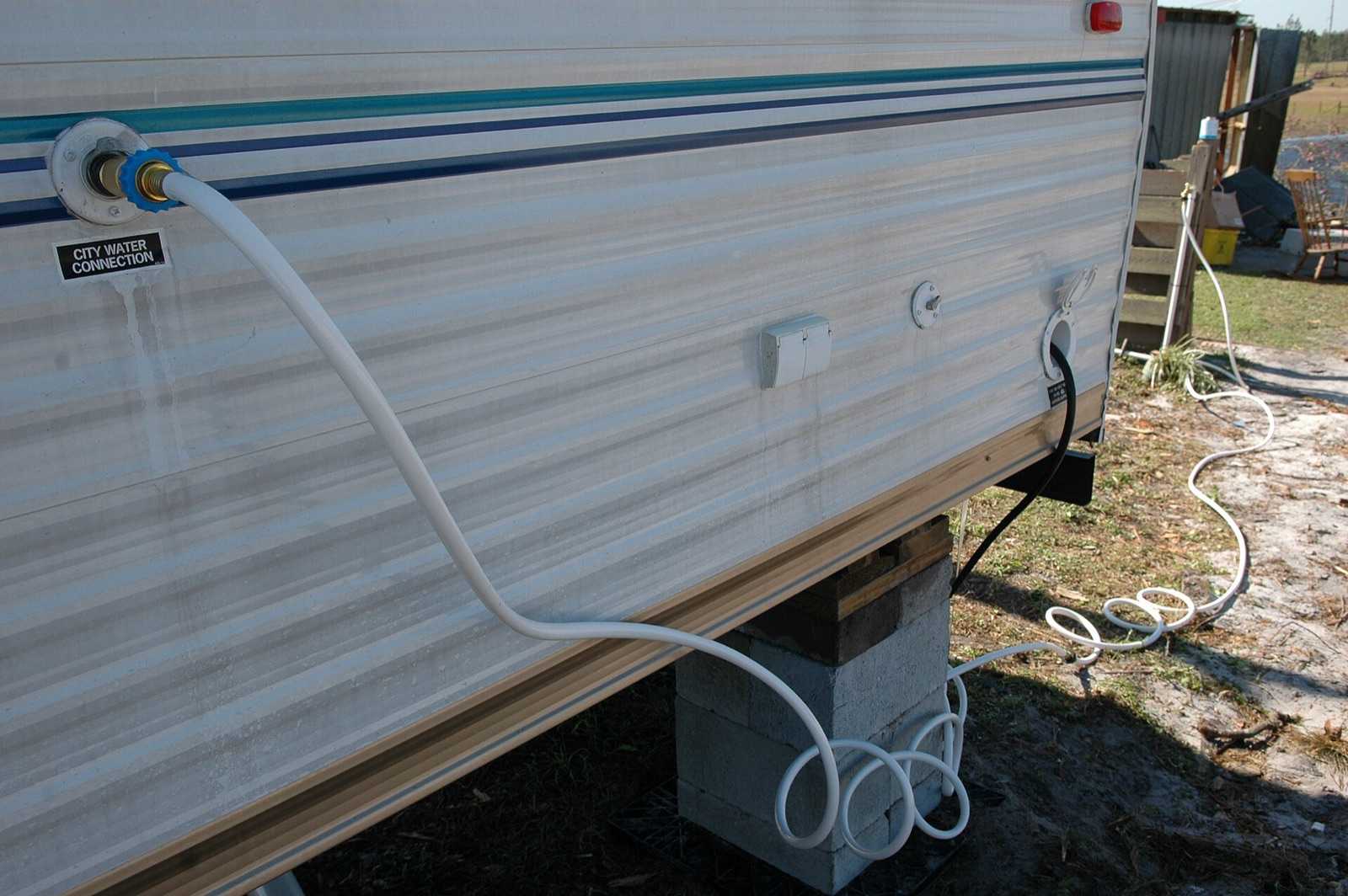
The city water connection on the outside wall has a spring-loaded check valve behind the hose fitting. Its job is to stop pump pressure from pushing fresh-tank water out the hose bib. When the spring tires or the rubber disc hardens, pump pressure pushes past it. From outside you will see a drip or a steady dribble at the city water fitting while the pump is on, and the pump cycles to replace it.
Open the inlet cap and look while the pump is pressurized. Any water showing means the check valve is passing. The whole inlet fitting is cheap and replaces from outside in about 15 minutes with a putty knife, new butyl tape, and four screws. Some inlets have a serviceable check valve cartridge instead; look before buying.
The same failure runs the other way when you are connected to city water. A bad inlet check valve is fine in that direction (it is open on purpose), but a bad pump check valve lets city pressure push water backward through the pump and into the fresh tank. A fresh tank that fills itself and overflows at the vent while you are on city water is this, not a mystery.
Step 4The pump’s internal check valve
Shurflo 4008, Flojet Triplex, and most Seaflo pumps have a check valve in the pump head so water cannot drain back to the tank when the pump stops. If it fails, pressure bleeds back toward the tank and the pump cycles with everything closed, usually every few minutes rather than every few seconds, with no wet spot anywhere.
Test it by isolating the pump. If you have a shut-off valve on the pump outlet, close it; if not, pinch the outlet hose or add a shut-off while you are in there. Pressurize, turn the pump switch off, wait, turn it on. If the pump runs immediately (pressure dropped with the outlet blocked), the leak is in the pump head itself: the check valve or the diaphragm. Shurflo sells a check valve and upper housing kit for the 4008 series; on a budget pump, replace the pump.
Step 5Suction-side air leaks
A pump can pull air without dripping a drop. The tank-to-pump hose is under suction when the pump runs, so a loose barb clamp, a cracked strainer bowl, or a dry O-ring draws in air instead of leaking water. The pump sounds hollower and faster, the faucet spits, and the pump may cycle after shutoff as the air pocket compresses.
Check the tank-to-pump hose at every fitting, tighten the strainer bowl by hand, and replace its O-ring if flattened. Check the tank’s outlet fitting too; it is often a plastic barb threaded into a plastic tank and it loosens over years of vibration.
On the pressure side, wrap a dry paper towel around each fitting, pressurize, and come back in ten minutes. A damp towel finds a drip a flashlight will miss.
Step 6Water heater bypass position
The bypass valves behind the water heater (one, two, or three depending on the kit) route water through the tank in summer and around it in winter. One valve left in the wrong position starves the heater or leaves the tank filling slowly through a cracked valve. If the rig was just de-winterized, confirm the bypass is fully in the normal position and the heater is full before chasing a pump problem.
Step 7Inlet strainer
The clear-bowl strainer on the pump inlet does not cause cycling directly, but a clogged screen restricts flow and makes low-flow pulsing worse. Unscrew the bowl, rinse the screen, and reinstall with the O-ring seated.
Step 8Accumulator tank
An accumulator is a small tank with a rubber bladder and an air charge, plumbed into the pressure side near the pump. When the pump runs, it compresses the air; when a faucet opens at low flow, the stored water feeds the faucet and the pump stays off longer. It does three things: smooths the trickle pulsing, extends the time between cycles, and reduces water hammer.
The Shurflo 182-200 ships pre-charged at about 30 psi. The general rule from the pump makers is to set the air charge a few psi below the pump’s cut-in pressure, and cut-in is typically 15 to 25 psi below cut-off. Check it with a tire gauge at the Schrader valve with the water system drained to zero pressure. A bladder with no air charge is a water-filled jug and does nothing.
Worth adding if the trickle pulsing bothers you. Not worth adding to hide a leak; it makes the cycling less frequent and harder to find.
Step 9Pressure switch adjustment
Shurflo 4008 and 4048 pumps have a small adjustment screw on the pressure switch cover. Turning it clockwise raises the cut-off pressure; counterclockwise lowers it. The usable range is small, a handful of psi, and the factory setting is already near the top of what the pump can deliver.
Only touch it if the pump shuts off well below its rated pressure (check with a gauge on a hose bib adapter). Turn it an eighth of a turn at a time and retest. Crank it too high and the pump cannot reach cut-off, so it runs forever and heats up. A full turn with no change means the switch is failing; replace it.
The sibling symptom: pump runs and never shuts off
A pump that runs continuously with everything closed is losing pressure faster than it can make it, or it is not making any.
- Fresh tank empty, or the tank outlet is above the water line on a rig parked nose-high. Level the rig and check the tank.
- Water heater bypass open so the pump is filling the heater, or a drain plug missing from the water heater after winterizing. The anode rod or drain plug is the one that gets forgotten.
- Low-point drains open, or an outdoor shower valve left on with the head closed, or a burst line from freezing. Walk around the rig and look underneath.
- Air lock. Open the farthest faucet on both hot and cold and let it run until it stops spitting.
- Pressure switch failed closed or the adjustment screw turned too far. The pump builds pressure but never stops. Back the screw out; if that does nothing, replace the switch.
- Torn diaphragm. The pump runs, sounds normal, and moves little or no water. Rebuild kit or new pump.
Symptom → likely cause
| What you see | Most likely | Check |
|---|---|---|
| Pulses two or three times a second while a faucet trickles | Normal demand-pump behavior | Add accumulator if it bothers you |
| Cycles every few seconds, all fixtures closed | Toilet valve weeping, or city inlet check valve | Look in bowl; open city inlet cap and look for water |
| Cycles every few minutes, all fixtures closed, no wet spots | Pump internal check valve | Isolate pump outlet and retest |
| One cycle every 15-30 min, all closed | Small drip at a fitting | Paper towel on every fitting |
| Sputters at the faucet, pump sounds hollow | Suction-side air leak or low tank | Strainer bowl, inlet hose clamps |
| Fresh tank overflows on city water | Pump check valve passing backward | Replace check valve or pump |
| Runs continuously, water at faucets | Open drain, bypass, or large leak | Low-point drains, water heater plug, underside |
| Runs continuously, little water | Empty tank, air lock, or torn diaphragm | Tank level, bleed the farthest faucet |
| Shuts off well below label pressure | Pressure switch drifted | Gauge test, small adjustment |
Stop and call an RV technician if: you find water inside a wall or under the floor that has been there long enough to soften the plywood (the plumbing fix is easy; the structural repair is not); the pump wiring or fuse holder is hot or discolored, which means a motor drawing more than it should; or the leak is at a fitting on the water heater's gas side you are not sure about. Pump work is 12 V and low pressure, and nothing here is dangerous on its own. The water damage is what gets expensive.
Parts and tools mentioned
- Replacement city water inlet with check valve, or inlet check valve cartridge for your model
- Shurflo 4008 check valve / upper housing kit, or complete pump (4008-101-E65 or equivalent)
- Shurflo 182-200 accumulator tank or equivalent, tire gauge for the pre-charge
- Pump inlet strainer O-ring, or complete strainer (Shurflo 255-313 pattern; verify)
- Toilet water valve (Dometic 385311641, Thetford 31705; verify against your toilet model)
- Hose clamps, butyl tape or sealant for the inlet, paper towels, flashlight
Questions people ask next
Should the pump cycle at all with everything closed? No. Once it reaches cut-off it should stay silent indefinitely, hours or days. One cycle an hour is a tiny leak, but it is still a leak.
Can I just leave the pump switch off between uses? You can, and plenty of people do. It stops the night cycling and lowers the risk of a small leak running unattended. It does not fix the leak, and a bad city-inlet check valve will still drip while you are on city water.
Is a variable-speed pump worth it? Variable-speed pumps (Remco Aquajet, some Shurflo Pro models) slow the motor to match demand and nearly eliminate trickle pulsing without an accumulator, at two to three times the price. If the fixture test passes, it is a comfort upgrade, not a repair.
The pump cycles only after I use hot water. Why? The water heater’s pressure relief valve weeps as the tank reheats and expands the water. Look for a drip at the relief valve outlet outside after a hot draw. Re-establish the tank’s air cushion: shut off the water, open a hot faucet, lift the relief valve lever until it stops flowing, then close everything and repressurize.
Photos

Manuals and references consulted
- Pentair Shurflo 4008 Revolution and 2088 Classic Series pump data sheets and installation instructions
- Xylem Flojet 03526 Triplex Series installation and operation manual
- Seaflo 42-Series diaphragm pump data sheet
- Pentair Shurflo 182-200 accumulator tank installation sheet